







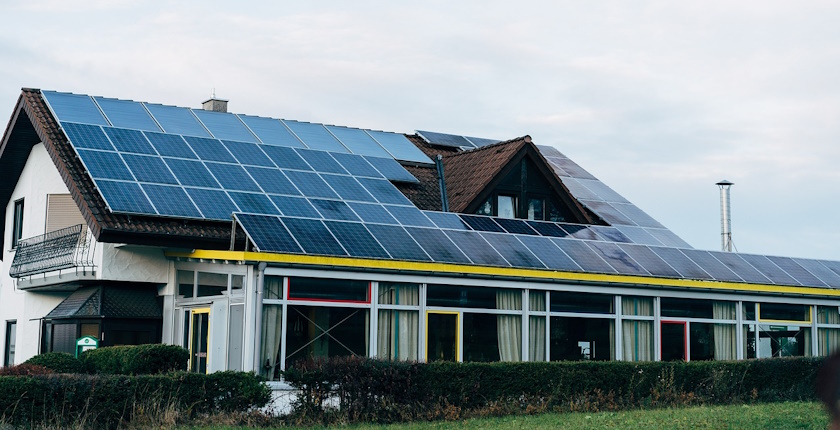
Photo: Markus Winkler from Pixabay


European Union member states have drastically increased their solar power goals by 2030 under updated national energy and climate plans, according to an analysis of the 26 drafts.
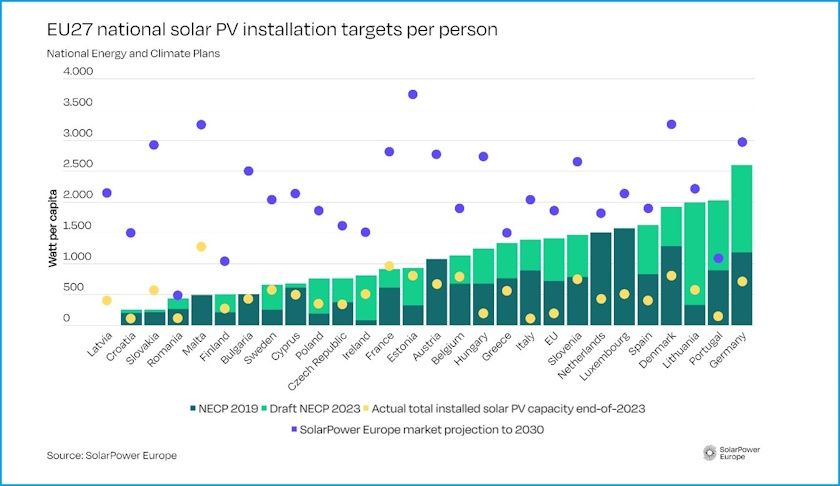
With 26 of 27 EU countries having submitted their updated national energy and climate plans (NECPs), they boosted solar targets by 87% from the previous versions, by weighted average, SolarPower Europe said.
Governments are banking on renewables more than ever but grid and flexibility planning trail far behind renewable goals, putting the energy transition at risk, the organization added.
EU member states were supposed to submit their draft updated NECPs last summer. The only one missing is Austria. Its NECP is “on hold indefinitely,” SolarPower Europe pointed out. The European Commission in 2019 approved the previous round of plans in 2019.
According to the analysis, Lithuania and Ireland stand out by multiplying their respective targets by more than five and 10, respectively. Poland multiplied its target by three while Finland, Portugal, Slovenia, and Sweden more than doubled their previous targets. Spain raised its ambition by 95%, the report reads.
NECPs lack long-term support schemes, targets for prosumers
Most NECPs are failing to provide long-term visibility up to 2030 by presenting support schemes, the association stressed. Investors need a clear view on auction pipelines but also on self-consumption schemes, especially as net metering is phased out, it added.
When it comes to decentralized photovoltaic generation, only Spain, France, Croatia, Ireland, Portugal and Romania provided quantitative targets for rooftop PV. The rest don’t distinguish between rooftop and utility-scale facilities, which is problematic for the visibility of the rooftop market, the report’s authors underlined.
The description of the support dedicated and trajectory for prosumers or energy communities is, in most cases, limited or partial, they said. Only Greece, France, Ireland, Italy and Lithuania provided sufficient details on prosumers while Germany, Greece, Ireland, Italy and Poland passed in the energy communities segment, the document reads.
Bonadio: Without proper system planning, solar projects will be held up, solar energy will be wasted
Jonathan Bonadio, Senior Policy Advisor at SolarPower Europe, said Europe risks putting the cart before the horse. “Energy system planning needs to be in sync with energy generation targets. Without proper energy system planning, solar projects will be held up, solar energy will be wasted, and the business case of solar will be undermined,” he stressed.
According to the report, NECPs fail to truly connect the dots with what now matters to make the energy transition a reality: grid deployment, modernization, and flexibility. Less than half of EU countries have appropriate energy storage targets, only two plan relevant investment in their distribution grid, while just four provided a real target for demand-side flexibility via smart meter rollut or demand-side response: Belgium, Bulgaria, Cyprus and Croatia.
Only two countries have set a target or an investment plan for distribution grid
This demand-side gap risks discouraging citizens’ adaptation to the new energy reality, the report reads.
Its authors highlighted demand-side flexibility as a main tool to lower investments in slow-to-build grid infrastructure.
When it comes to energy storage, dedicated targets in terms of megawatts, megawatt-hours or euros were included in the plans for Belgium, Bulgaria, Cyprus, Greece, Spain, Croatia, Hungary, Lithuania and Portugal.
Though a lack of storage infrastructure or demand-side response will undoubtedly and unnecessarily put pressure on the electricity grid, only France and Malta set a target or investment plan for the distribution electricity grid, the analysis reveals.
Total ambition for 2030 is seen at 626 GW, compared to the EU Solar Strategy target of 750 GW and the industry potential of 902 GW, SolarPower stressed.
Governments now have until June 30 to submit any updates before their plans are considered final.



Be the first one to comment on this article.