






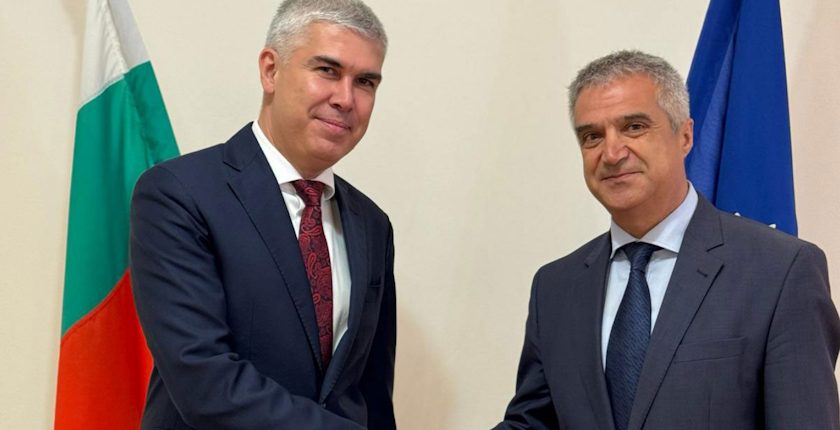
Photo: Vladimir Malinov (pictured left) and Rumen Radev (Ministry of Energy)


Dimitar Glavchev’s interim Council of Ministers of Bulgaria includes Acting Minister of Energy Vladimir Malinov. As the head of Bulgartransgaz, he ran the Balkan Stream project for the extension of the TurkStream gas pipeline.
A caretaker cabinet led by Acting Prime Minister Dimitar Glavchev took over from Nikolai Denkov’s government ahead of the June 9 snap election, the fifth one in just under three years. The date coincides with the European election.
Acting Minister of Energy Vladimir Malinov, who replaced Rumen Radev, quit as chief executive of gas transmission and storage system operator Bulgartransgaz to assume the new role. He led the company since 2018, when former Prime Minister Boyko Borissov’s GERB was in power. Still, Malinov kept his post in the period when the party was in opposition. Glavchev is also from GERB.
Russian deals
Since 2019 Malinov has chaired the board of Balkan Gas Hub. He is also a board member of Gastrade, which is completing the liquefied natural gas (LNG) terminal in Alexandroupolis in neighboring Greece.
The backlash caused by an offshore wind power bill contributed to the downfall of the former cabinet
As the head of Bulgartransgaz, he ran and promoted the Balkan Stream pipeline project, the extension of the Turk Stream toward Hungary through Serbia. It earned him a reputation, among critics, of being pro-Russian. Domestic media pointed out that under his watch the company signed a supply deal with Turkey that favors Russian gas and that the expansion of the Underground Gas Storage Chiren facility was delayed, as was the development of the so-called vertical gas corridor to Ukraine and Moldova.
Perils of electricity market liberalization
At the handover with now former Minister Rumen Radev, Malinov said the priorities include electricity market liberalization and the completion of the Integrated National Energy and Climate Plan (INECP or NECP) and national energy strategy. The aim is to ensure affordable, sustainable and secure energy supply, according to the ministry.
Bulgaria has been accelerating its energy transition, leaning primarily on photovoltaics, like most other countries. But the path of the replacement of coal-fired power plants is increasingly unclear, especially with the said liberalization. It may jeopardize the security of energy supply, thousands of jobs and major parts of the economy.
Interestingly, the opposition among environmentalists, the local population and businesses to an offshore wind power bill contributed to the downfall of Denkov’s coalition government, which lasted just ten months.
Malinov holds a master’s degree in law.


Be the first one to comment on this article.