





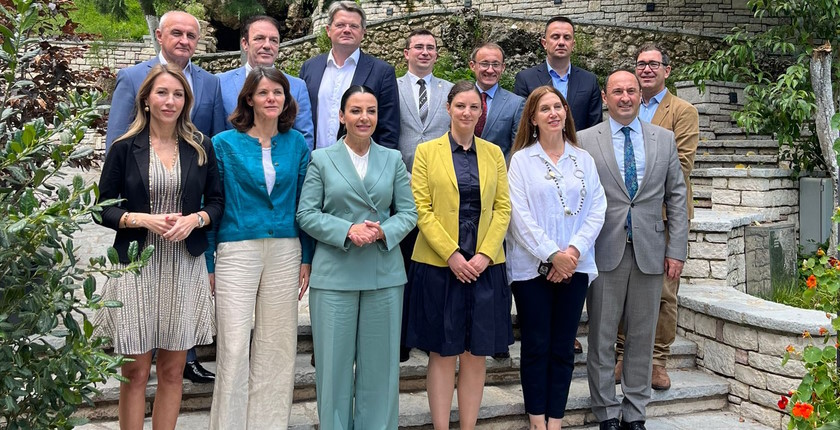
Photo: Ministry of Mining and Energy


Share


To take a position on carbon pricing, as part of the energy sector decarbonization, Serbia and other Western Balkan countries need financial support, primarily from the European Union (EU), according to Serbian Minister of Mining and Energy Dubravka Đedović. Speaking at an informal ministerial meeting of the Energy Community in Albania, she stressed that the process of establishing an emissions trading scheme must be economically sustainable and socially just.
Serbian Minister of Mining and Energy Dubravka Đedović said at an informal ministerial meeting of the Energy Community, held in Albania, that the potential introduction of a regional carbon emissions trading scheme, modeled after the EU’s Emissions Trading System (EU ETS), requires additional comparative analyses and appropriate financial support.
“Before initiating further activities related to CO2 taxation, it is necessary to analyze all possible options in order to select the mechanisms that will enable the region’s harmonization with the energy and climate policies of the EU in a way that would be economically sustainable and socially just,” she said at the meeting in the city of Tepelena. Serbia’s position is that before discussing any specific obligations and deadlines, it is necessary to conduct a comprehensive, detailed and comparative analysis regarding the implementation of a regional emissions trading system or some other mechanism, primarily when it comes to electricity generation, according to Đedović.
CBAM will cause far-reaching consequences for the economy and social relations
The consequences of potential decisions concerning the implementation of the EU’s Carbon Border Adjustment Mechanism (CBAM) will be serious and far-reaching for the economy and social relations, and it is necessary to conduct adequate analyses at the national level that would inform the government’s political positions, she added.
Given the GDP per capita and the share of coal in electricity production in Serbia and the region, taking a position on carbon pricing, as part of the energy sector decarbonization, is not possible without ensuring appropriate financial support, primarily from the EU, said Đedović.
Western Balkans needs a special just transition fund
“The Energy Community contracting parties, including Serbia, are only at the beginning of a just energy transition, but we already need to predict future costs, and thus the appropriate sources of funding for decarbonization, as is the case in the EU, where the Just Transition Mechanism provides EUR 100 billion in support to member states,” she explained.
One of the possible solutions, in her view, is to set up a Western Balkan just transition fund – a regional fund that would mobilize additional funding with the support of the EU. The funding would be intended for economic diversification in the hardest-hit regions, worker reskilling, support to small and medium-sized enterprises and the opening of new businesses, research and innovation, the ecological restoration of coal regions, clean energy generation, and a transition towards low-carbon technologies, according to Đedović.

Be the first one to comment on this article.