






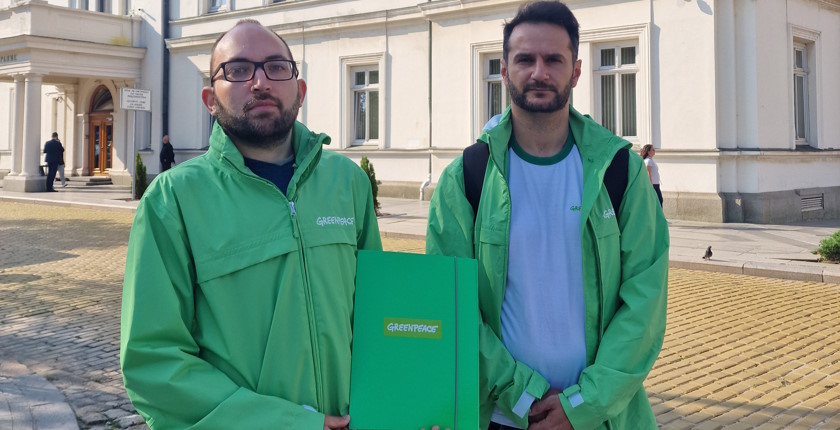
Photo: Balin Balinov and Kristiyan Dimitrov from Greenpeace Bulgaria submitted the request to the country's parliament (Greenpeace)


A group of local authorities in Bulgaria requested from the National Assembly and the country’s government to enable the creation of energy communities and support investments in small renewable energy installations for self-consumption.
A group of Bulgarian municipalities wrote an open letter to the country’s parliament and the new government, asking for assistance in strategic climate planning at the local level. The document, focused on a request to provide the possibility to establish energy communities, also highlights the need to reduce greenhouse gas emissions and risks on a national level, as well as to conduct a vulnerability analysis for all regions.
Greenpeace Bulgaria coordinated the effort and submitted the letter to the National Assembly. There is no legal framework for the creation of energy communities yet, the organization pointed out.
Bulgaria is late in transposition of EU law
The European Commission earlier launched a procedure against Bulgaria, which is two years late in introducing simplified procedures for households and energy communities to produce energy for self-consumption, the report adds. The legislation is part of the European Union’s Renewable Energy Directive.
As parliament is currently working on changes to the Energy from Renewable Sources Act, now is the chance for energy communities to be recognized in the national legislation, according to the environmentalists.
The municipalities requested a unified system for informing and supporting local authorities in finding opportunities for financing low-carbon projects and exchanging information on new technologies and solutions, the letter reads.
Fair, equal access to funds to all local authorities
It is extremely important that municipalities in Bulgaria advance simultaneously in the energy transition to clean energy sources of electricity, heating and transport, according to the statement. The local authorities stressed they must have fair and equal access to European and national funds for the transformation that would improve people’s quality of life, make the environment cleaner and mitigate climate change.
The EU’s solar energy strategy recommends that by 2025, every municipality with a population of over 10,000 should establish at least one energy community. Such initiatives can be fully citizen-driven or organized together with local government. Energy communities and energy cooperatives can also be founded with or consist only of public companies, institutions, civil society organizations or businesses.

Be the first one to comment on this article.