






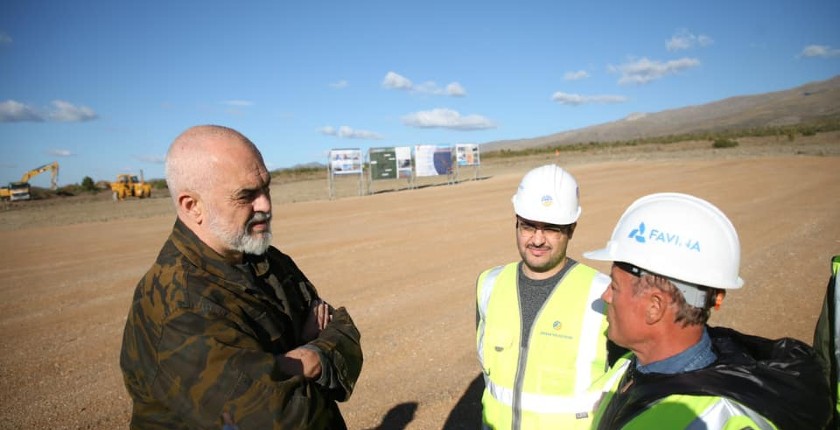
Photo: Edi Rama / Facebook


Works on the Erseka Solar Park near Korça in Albania are in progress. The first two segments are planned for 40 MW, which would currently make it the largest facility of its kind in the country, and the capacity should later be doubled.
Prime Minister Edi Rama visited the construction site of the Erseka Solar Park in Kolonja in Albania’s southeast, after his government gave the green light in June for starting the works. The developers, Favina, Favina 1 and M&K Energy Trading, have received two approvals for 20 MW each. They intend to subsequently expand the solar power plant in the Korça county to 80 MW.
The Erseka facility didn’t require a concession and it won’t benefit from any state support measures, according to the official documentation. The permits for the first two segments are valid for 24 months since they were issued.
The government doesn’t plan any subsidies for the Erseka Solar Park
As for royalty payments, the operator is obligated to cede 2% of annual electricity production or give an equivalent financial compensation to the Ministry of Infrastructure and Energy.
The project is envisaged to be connected through a future 110 kV/ 35 kV substation and a 110 kV power line. The investors have taken 102 hectares on lease for the Erseka Solar Park.
The three companies said the 40 MW project is worth EUR 30 million and that they secured international loans for the construction of the photovoltaic park. Annual output from 80 MW in capacity is estimated at 170 GWh.
The investors said they secured international loans for the EUR 30 million project
Prime Minister Edi Rama expressed confidence that Albania would reach energy independence by 2029 at the latest. The country relies on hydropower plants for almost 100% of domestic electricity output, which makes it vulnerable to droughts. At their maximum capacity, hydroelectric facilities can cover 75% of consumption, Rama pointed out earlier.
The government is rapidly increasing the planned renewable energy capacity, but very few projects have reached the construction phase.
One exception is French developer Voltalia, which broke ground in July on its 140 MW solar power project Karavasta.

Be the first one to comment on this article.