






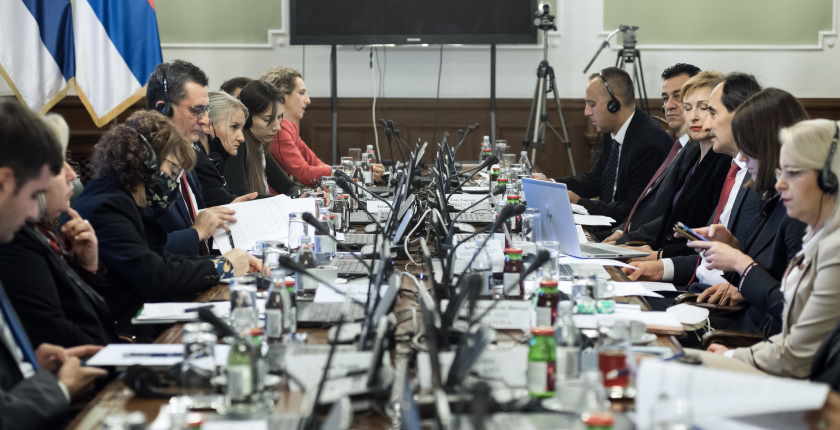
Photo: Energy Community/Twitter


Western Balkan countries will be obligated to introduce carbon pricing by 2025, said Janez Kopač, outgoing Director of the Energy Community Secretariat.
Janez Kopač noted that the Ministerial Council of the Energy Community meeting would be held in Belgrade on November 30 and announced that several European Union directives would be adopted, including those on energy and climate policy, renewable energy sources, and energy efficiency. He stressed that the directive on energy and climate policy also refers to preparing national energy and climate plans (NECPs).
Kopač highlighted the upcoming discussion on a decarbonization roadmap as very important.
The document, which should be adopted at the meeting, envisages the introduction of a CO2 tax no later than 2025, Kopač told N1 television after the Parliamentary Forum of the Energy Community in Belgrade.
Introducing a CO2 tax is the best way to decarbonize the economy and energy
He stressed carbon pricing is the best and practically only way for the economy, energy, and other sectors toward greater use of renewable energy sources and the implementation of energy efficiency measures.
He underscored that the tax would bring income that can be used for the energy transition and to finance the coal regions’ transformation.
The energy transition will certainly last until 2050
Kopač also said introducing a CO2 tax at the national level is a better solution than the carbon border tax (Carbon Border Adjustment Mechanism – CBAM) announced by the EU for 2026. In the first case, the money remains in the countries that introduce it, and in the second, it goes to the EU budget.
Nevertheless, in his words, the energy transition is a long-term process, and it is clear that coal-fired power plants will operate in Serbia for decades to come.
The transition will almost certainly last until 2050, Kopač said.




Be the first one to comment on this article.