







Photo: catazul from Pixabay


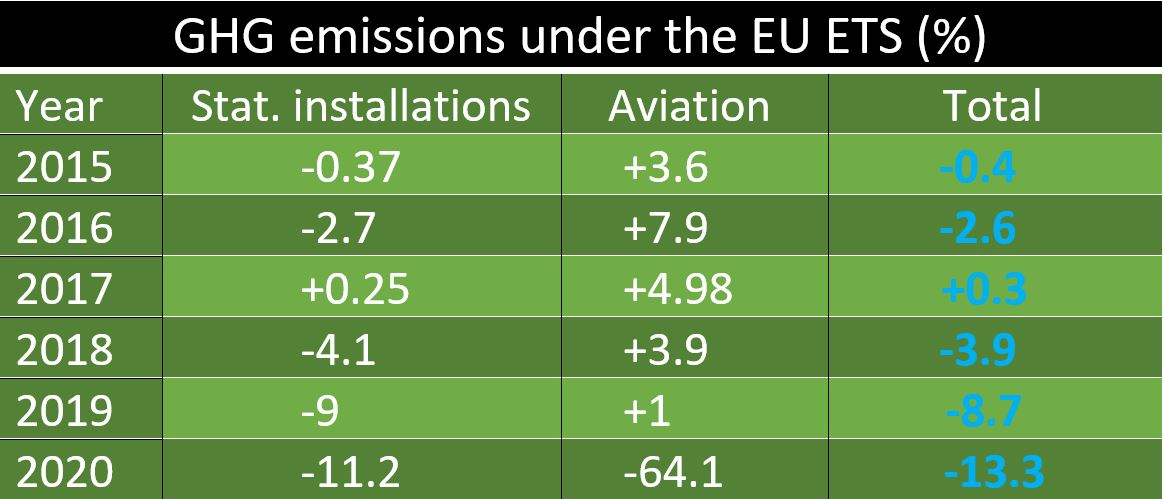
Greenhouse gas (GHG) emissions from operators covered by the EU Emissions Trading System (EU ETS) in 2020 fell by 13.3% against 2019. The sharpest decline since 2015 was driven by the COVID-19 pandemic impact on aviation.
Emissions from aviation dropped 64.1% in 2020, in the sector’s first decline since 2015. An 11.2% decrease from stationary installations is a part of the trend, but it is the largest in the last six years.
As one of the sectors most vulnerable to the COVID-19 pandemic, aviation saw the steepest reduction in emissions, according to the European Commission website.
The EU ETS covers more than 11,000 power plants and manufacturing installations in the 28 EU Member States and Iceland, Norway and Liechtenstein, as well as emissions from around 500 airlines flying between European airports.
Emissions from power plants decreased by 14.9%
Verified emissions of greenhouse gases from stationary installations (power plants and manufacturing installations) amounted to 1.331 million tonnes of CO2-equivalent in 2020.
The power sector saw a 14.9% decrease, reflecting both reduced electricity consumption due to the pandemic and previously identified decarbonization trends. These include both the switch from coal to natural gas-fired power generation, and the replacement of fossil fuels with renewable energy sources. The result in 2020 was similar to last year’s 15%, when there was no COVID-19.
Emissions from industry decreased by an average of 7%
Emissions from industry decreased by an average of 7%, with reductions observed in most sectors, including iron and steel (-11.7%), cement (-5.1%), chemicals (-4%) and refineries (-8.1%).
However, with current data, it is not yet possible to determine what proportion of these reductions is due to increased emissions efficiency, the European Commission said.
COVID-19 crisis drives decrease in airlines emissions
Emissions from airline companies reached 24.5 million tons of CO2 in 2020. This was approximately 64.1% lower than the 68.2 million tons of CO2 recorded in 2019. As is the case with industry, it is not possible to determine how much of this decline can be attributed to gains in emissions efficiency.
Under the EU ETS, all operators (stationary installations and airlines) were required to report their verified emissions of 2020 by March 31, 2021. Although not yet definitive, the reporting rate is higher than 95% for most sectors and countries.




Be the first one to comment on this article.