






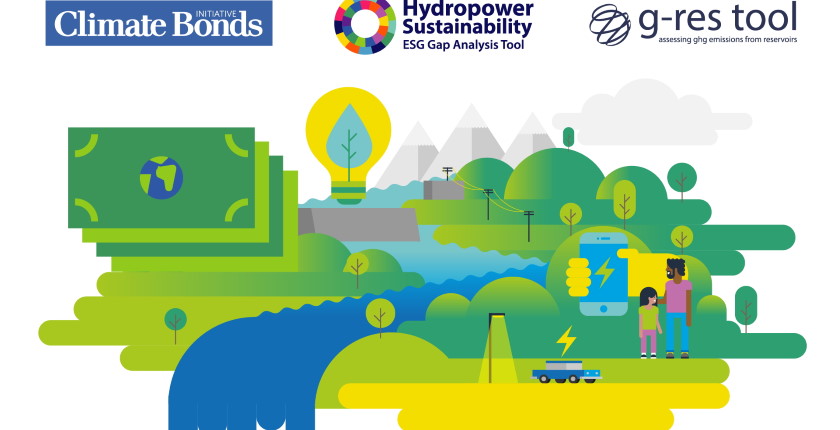
Photo: Climate Bonds Initiative


Hydropower developers and operators that want to raise funds via green bonds can now certify that they meet environmental standards with an assessment by using CBI’s tools to determine the environmental, social and governance (ESG) performance. Hydropower Sustainability ESG Assessment Fund prepared grants for the assessments including for firms from four countries of the region.
The International Hydropower Association (IHA) said the hydropower criteria introduced by the Climate Bonds Initiative – CBI under the international climate bonds standard clears the way for significant green investment in sustainable hydropower projects. Planned and finished hydropower projects of all sizes will be eligible for financing provided they meet strict qualifying criteria, in line with the new best practice guide for investors.
To be eligible for a climate bond, projects will need to commission an assessment using the Hydropower Sustainability ESG Gap Analysis Tool (HESG) and the G-res Tool for reporting greenhouse gas emissions. IHA participated in the technical working group that advised CBI in developing the criteria.
Opening way for issuers of green debt for hydropower
“CBI’s new climate bonds standard criteria now clears the way for significant additional investment in sustainable hydropower. It provides the clarity and assurance that investors, governments, the industry, as well as local communities, have demanded for years. To qualify, new and existing projects must now assess their environmental, social and governance (ESG) performance and report a low carbon footprint,” according to IHA.
The standard is much stricter for those that seek funds if their facility was commissioned in 2020 or later
Certification for hydropower is now formally available for issuers of green debt products across all markets. The technical working group included representatives from the World Wide Fund for Nature (WWF), Alliance for Global Water Adaptation (AGWA), International Union for Conservation of Nature (IUCN) and other stakeholders. CBI is a not-for-profit organization responsible for green bond certification.
The issuer must demonstrate it has either a power density of more than 5 W per square meter or an emissions intensity of less than 100 grams of carbon dioxide equivalent per kilowatt hour if the facility was operational pre-2020, and either a power density of more than 10 watts or an emission intensity of less than 50 grams of CO2 equivalent for facilities operational from 2020 on.
No loose ends
The majority of gaps against international good practice must be closed within 12 months and the remaining within 24 months. A number of debt issuers have already sold green bonds to finance or refinance hydropower projects, CBI said.
Last month, a sustainability fund to help hydropower developers and operators assess their ESG performance issued the second call for entities in more than 40 countries. The Hydropower Sustainability ESG Assessment Fund will award a total of CHF 1 million to 40 or more hydropower projects over four years.
IHA’s non-profit sustainability division manages the initiative, while it is funded by the Swiss State Secretariat for Economic Affairs (SECO). Beneficiaries will receive grants to partly cover the cost of commissioning an independent project assessment using HESG.
The assessment involves a site visual inspection and interviews with stakeholders and concludes with an official report and a gap management plan. Hydropower project developers and operators can apply by May 5.
The current call concerns CHF 350,000 for 14 projects in total. Bosnia and Herzegovina, Kosovo*, North Macedonia and Serbia are on the list.



Be the first one to comment on this article.