


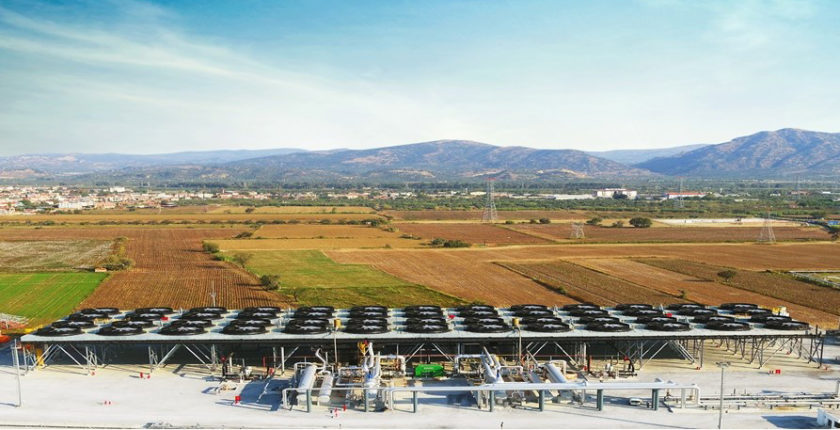
Turkey’s Gurmat Elektrik, a renewable energy subsidiary of Güriş Holding, has secured a USD 350 million financing package for three new units at EFELER, the country’s largest geothermal power plant, according to a joint press release from three major development banks.
EFELER is located in western Turkey, in the region of the Buyuk Menderes Graben basin, the area in Turkey with the greatest potential for geothermal energy.
Of the three new units, EFE-6 with a 22.6 MW capacity and EFE-7 with 25 MW are already operational. EFE-8 with a capacity of 50 MW is still under construction.
When fully completed next year, the plant’s eight units will have a total installed capacity of 260 MW.
Under the financing package, Gurmat Elektrik will receive a USD 100 million loan from the Asian Infrastructure Investment Bank (AIIB), a USD 60 million loan from the European Bank for Reconstruction and Development (EBRD), and a USD 20 million loan from the Black Sea Trade and Development Bank (BSTDB)
In parallel, Turkey’s largest commercial lender Isbank is providing a USD 90 million loan, and the Industrial Development Bank of Turkey TSKB and ICBC Turkey are making loans of USD 50 million and USD 30 million, respectively.
Gurmat Elektrik was established in 1999 to construct and operate a set of geothermal power plants based on the Germencik geothermal field in Western Anatolia. Currently, Güriş has Turkey’s second largest geothermal power plant portfolio, which represents almost one-fifth of the country’s total capacity, according to the EBRD’s website.
Turkey global leader in adding new geothermal capacity in 2018
Turkey was the global leader in adding new geothermal capacity in 2018, with 219 MW.
The country completed several geothermal power projects in 2018, raising its installed capacity by 21% or 219 MW, to 1.3 GW, according to a report by think tank Renewable Energy Policy Network for the 21st Century Report (REN21).
Turkey ranks fourth globally for cumulative geothermal power capacity, having built up more than 1 GW of capacity in only six years, between 2013 and 2018, according to the Renewables 2019 Global Status Report.
An estimated 0.5 GW of new geothermal power generating capacity came online in 2018, bringing the global total to around 13.3 GW.
The largest single unit completed in 2018 was the 65.5 MW Unit 2 at the Kizildere III plant, which at that time became Turkey’s largest geothermal power plant (165 MW).