


State and local government institutions and public services in Montenegro have a deadline until May 7 to apply for co-financing the purchase and installation of electric vehicle (EV) chargers. A total of EUR 60,000 is available as part of the project Development of Low Carbon Tourism in Montenegro, implemented by the United Nations Development Program (UNDP), in cooperation with the Ministry of Sustainable Development and Tourism, and with the financial support of the Global Environment Facility (GEF).
According to the public call published by UNDP, the applicant is obliged to provide free charging service to all EV users for a period of 1 year from the moment the e-charger is available.
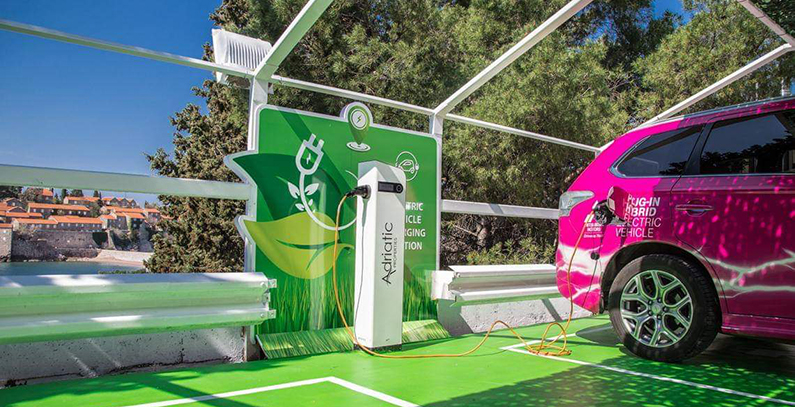
Montenegro has recently unveiled the first public e-charger, which was set up at Sveti Stefan island. The technical solution was developed by Crnogorski Telekom, which announced that it will install EV chargers in Žabljak, Pljevlja, Cetinje, and Tivat by June.
Under the UNDP public call, co-financing can range from 50% to 70% of the total costs of the purchase, preparatory work and commissioning of EV chargers, depending on the number of applicants. Acceptable costs include all expenses related to preparatory work, installation, and commissioning of e-chargers.
The expenses of the contracted rate of power input do not represent acceptable cost.
EV chargers will be co-financed with the following technical characteristics:
AC sockets “type 2”
– 1 socket with minimum power of 22 kW
– 1 socket with minimum power 11.01 kW
– in accordance with international standards IEC 62196, IEC 61851 and EN62196-2),
– maximum AC output current 3 x 32 A,
– nominal AC output voltage 230/400 V.
The aim of the public call is to encourage the public sector to develop and set up the crucial infrastructure for the development of e-mobility in order to apply innovations in the transport sector, secure charging points to foreign tourists who wish to travel to Montenegro by EVs, strengthen the economy, create green jobs , increase the availability of information and interest of the Montenegrin public in e-mobility, and reduce the level of GHG emissions, according to the public call.
According to Montenegro’s statistical office Monstat’s data, 106 EVs were registered in Montenegro last year.
These vehicles are used in tourist resorts of Porto Montenegro, Luštica bay, Sveti Stefan and Slovenska Plaža, for the transport of guests, RTCG reported.