


With energy poverty emerging as one of the most dramatic symptoms of the recession – six out of every 10 households are struggling to pay their energy bills – it is high time that Greece seized upon its greatest and still largely unexploited asset, said Kumi Naidoo, executive director of environmentalist pressure group Greenpeace International, in an article for the Huffington Post.
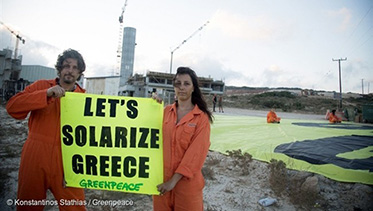
In late July Greenpeace activists protested on the island of Rhodes in the Aegean. They unfurled a 600 square metre banner pointing towards an oil fired power plant currently under construction. The banner said: ‘Oil is fueling Greek debt’.
The event was the launch of ‘Solarize Greece’ campaign by Greenpeace Greece with aspirations not only for that country but for the whole of Europe. Its objectives are to help Greece kick-start solar power as a driver of the economy, to rid the country of the burden of fossil fuels that are holding it down economically, Naidoo states.
The government offered tax incentives to households for solar water heaters in the 1970s, as policy was aimed at saving power, the column adds. “That led to hundreds of thousands of households installing solar heaters and significantly reduced energy bills. Equally important, a new industry was born and soon solar heaters became one of Greece’s finest export products,” according to Naidoo.
He claims it is time to revisit photovoltaic power and, this time, on a massive scale, after the ‘PV Spring’ of 2009– 2013, driven by a feed-in tariff scheme, when capacity jumped from 47 to over 2,500 MW.
Driven by the rapid fall in the costs of solar power, new legislation allows Greek citizens to generate cheap solar power for their own consumption, rather than selling it to the power grid, Greenpeace’s chief said, underscoring there is comparative advantage relative to northern European states. Sustainable investments, social welfare policies, pensions and stimulating prosperity can be funded with the EUR 800 million a year that subsidize oil imports to provide power to the country’s many islands, Naidoo added.
“Greenpeace Greece sees a different energy future, and that is what its crowdfunding campaign is all about. Installing solar power in Greece’s oil-dependent islands will bring relief to low-income households in need; it will help reduce oil consumption and pollution; and it will save money for Greek consumers on the mainland. Above all, it would be an example of a fair social policy that has tremendous developmental potential. Even more crucially, the campaign aspires to set in motion a transformation based on solarizing the entire Greek economy,” the author concluded.