

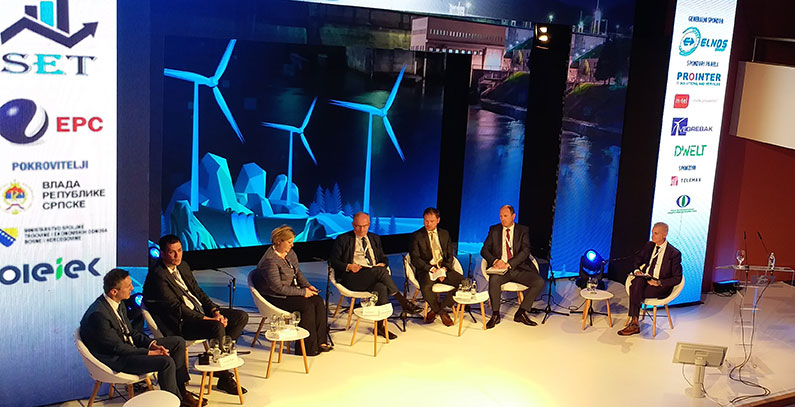
Investors are currently interested in developing 3,000 MW of wind power projects in Serbia, Dragan Vlaisavljević, executive director for electricity trading at state power utility Elektroprivreda Srbije (EPS), said at a panel titled “Regional Energy Review – Development Perspectives” held as part of Trebinje Energy Summit – SET 2020.
These 3,000 MW of wind power projects have already applied for connecting to the transmission system operator Elektromreža Srbije’s (EMS) grid.
Investors are coming to EPS to inquire about balancing costs
Many of these projects do not even need feed-in tariff as they are commercially viable without it, said Vlaisavljević, adding that these investors are coming to EPS to inquire about balancing costs.
Of the 3,000 MW, according to his estimate, around 1000 MW is commercially viable.
The average wind power intermittency in Serbia is ten times higher than in the North Sea
EPS is responsible for balancing for all wind farms is Serbia, and currently 360 MW are connected to the grid.
Wind power intermittency on the locations of the wind farms is considerable, with the average intermittency ten times higher than in the North Sea, according to him.
Continuous trading on electricity markets would additionally help EPS with balancing, but this is currently not feasible, Vlaisavljević said.
For balancing, EPS is using pumped-storage hydropower plant Bajina Bašta
For balancing, EPS is using pumped-storage hydropower plant Bajina Bašta, and Vlaisavljević believes that the planned pumped-storage plant Bistrica will also be built. It will have three reservoirs, enabling a better water utilization.
He noted that the energy transition is inevitable, but that Serbia must find an adequate pace of such changes.
In about two years EPS should complete its first wind farm, Kostolac, with an installed capacity of 66 MW, as well as a 10 MW solar power plant, while another one, with a capacity of 100 MW, is in the pipeline, according to him.
Participants in the panel also included Eva Šukleva, general manager of North Macedonia’s transmission system operator MEPSO, Luka Petrović, general manager of state power utility Elektroprivreda Republike Srpske (ERS), Drago Bago, executive director for development at state power utility Elektroprivreda Hrvatske Zajednice Herceg Bosne (EPHZHB), Ivan Mrvaljević, executive officer at the development and engineering directorate of Montenegrin state power utility Elektroprivreda Crne Gore (EPCG), and Mitja Tašler, CEO of thermal power plant Šoštanj, which operates as part of Slovenia’s Holding Slovenske Elektrarne (HSE).