


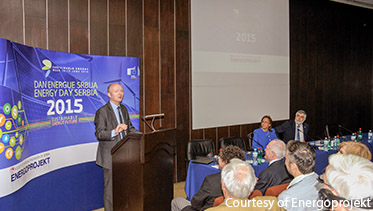
Out of initial 15 thermal plants, only the ones in Nova Varoš, Prijepolje, Mali Zvornik and Priboj will switch to biomass, in a project funded by KfW Development Bank, Miloš Banjac, assistant minister for mining and energy, said at the Energy Day conference. The project’s value has thus come down to EUR 20 million, Banjac said. The yearly event was organised fourth time in a row by the Society of Thermal Engineers of Serbia, in cooperation with Energoprojekt Entel AD within the European Union’s Sustainable Energy Week initiative – EUSEW.
Serbia and Albania advanced the most within the Energy Community in relation to the implementation of EU’s Third Energy Package, Janez Kopač, director of the Energy Community Secretariat, said during his presentation. The biggest problems are in Bosnia and Herzegovina and in Macedonia, the latter actually taking a step back, as consumers weren’t allowed to choose a power supplier, he added. “Energy Union is an efficient political slogan, as it perpetuates and intensifies discussions on what it really represents and on energy policy of the EU, which is at a crossroads. We are moving ever deeper into the field of renewable energy sources and the decarbonisation of the economy, with problems emerging, so they are to be solved through energy policy,” Kopač stated.
Green economy is a driver of economic growth and the number of jobs in that sector has risen significantly in the EU, despite the recession, said Freek Janmaat, head of the European integration section of the Delegation of the EU in Serbia. Agenda for renewable energy sources and climate change isn’t exclusive of growth policy, as evidence shows that the EU curbed emission of greenhouse gasses by 19% since 1990, while its gross domestic product grew by 45%, he added. Janmaat said Serbia needs clarity about the division of risks between the government and investors in renewables. The state should find balance between the difficult situation it is in and its commitment to the target of 27% share of renewable energy, and stimulate those projects, he underscored.
Development of power generation from renewable sources will bring huge amounts of electricity, which may help bringing its price down in a few decades, even to less than zero, making investment unprofitable, Arthur Heberle, vice president of Mitsubishi Hitachi Power Systems Europe, told Balkan Green Energy News. A major problem is volatility in generation, because there is, for instance, a lot of power from solar panels during the day, and none at night, or sometimes there is very little sunshine, he added, suggesting storage costs are a very important factor. “The best would be to reduce carbon dioxide emissions as much as we can, using the technology that would make it economical at the time. Conventional plants will remain, though,” Heberle said. At the conference, he presented the case of Germany in energy sustainability in Europe.