


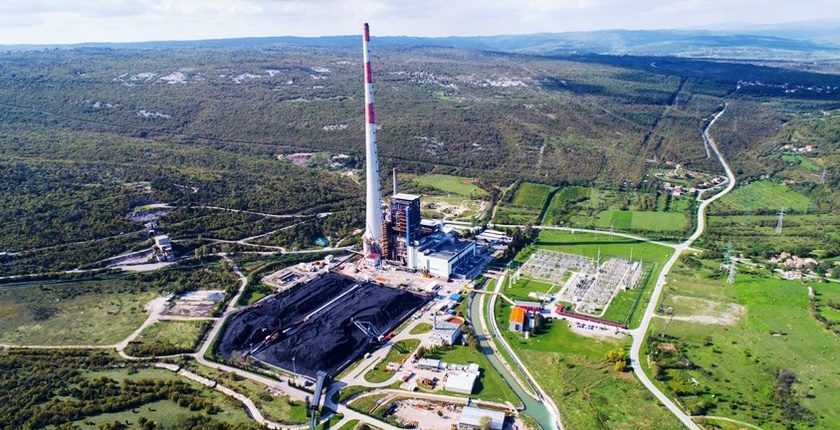
Croatia’s state-owned power utility Hrvatska Elektroprivreda (HEP) plans to install a solar power plant and an electrolyzer for hydrogen production at the site of its Plomin thermal power plant. It is the only Croatian coal-fired electricity unit.
HEP has launched a public call for the preparation of documentation for obtaining a location permit for a photovoltaic power plant and an electrolyzer at the location of the Plomin thermal power plant, the Labinština portal reported.
The plan is for TPP Plomin to cease operation in 2035, so HEP is considering the options to use its location.
Of note, at the beginning of June last year, HEP hired consultants to determine the best available techniques (BAT) for the use of alternative fuels – gas, biomass and waste – in the defunct unit A, with a capacity of 125 MW. It has been out of operation since late 2017.
Only one unit is operating at the Plomin Thermal Power Plant, and its closure is planned for 2035
TPP Plomin also has unit B, with a capacity of 210 MW, which is still generating electriciy. HEP also announced that it is planning a solar power plant with a capacity of 25 MW not far from the thermal power plant.
The state-owned power utility said in the public call that in line with the current situation in the electricity system, the state of the infrastructure and the transition to low-carbon energy sources, it proposed to use the location of TPP Plomin for the installation of an electrolyzer for the production of hydrogen and a solar power plant.
Hydrogen could be used for a variety of purposes
The photovoltaic plant would supply electricity to the electrolyzer or to the grid, in line with market trends.
The produced hydrogen can also be burned in the existing boiler of unit 2 (unit B) or by injecting it into the natural gas grid operator Plinacro, up to a maximum of 10%
There are other options as well. HEP can compress hydrogen and sell it to power trucks and ships, or it can charge and sell hydrogen batteries or generate electricity for frequency regulation in the power system.
Of note, Croatia previously said it intends to phase out coal by 2033.