


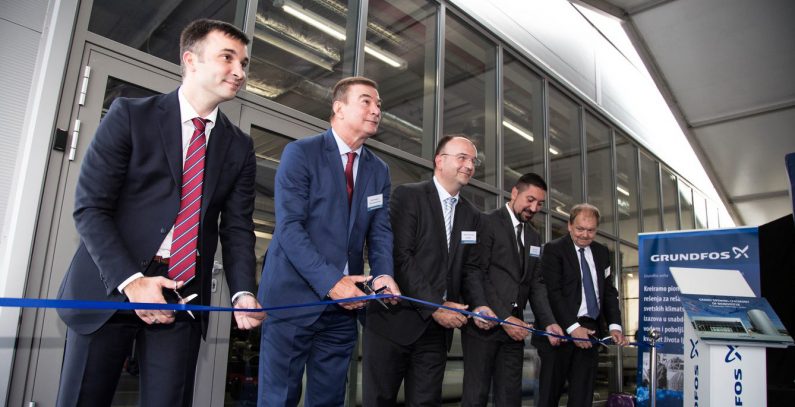
Denmark-based pump manufacturer Grundfos has unveiled the BioBooster wastewater treatment facility under a EUR 2 million investment at its plant in Inđija, Serbia, the first location outside Scandinavia to boast the state-of-the-art facility, the company said.
The facility in Indjija is working towards a closed-loop scenario, where the Grundfos BioBooster system is a key part of the puzzle. The BioBooster facility will treat all domestic wastewater, which accounts for 60-70% of the factory’s wastewater, the company’s press release reads.
Additional wastewater treatment technologies, as well as rainwater harvesting technology, will provide the additional steps towards realizing a closed-loop scenario where the large-scale industrial facility operates with minimal water footprint.
The Inđija facility’s opening coincided with the marking of the 10-year anniversary of Grundfos’ operations in Serbia and was attended by Serbian Economy Minister Goran Knežević and Denmark’s Ambassador to Serbia Anders Hougard, among other officials and the company’s executives.
The Inđija production site produces more than 4 million pump units a year and is Grundfos’ third-largest production facility worldwide. As such, the introduction of a closed-loop gives a high-level and scalable example of how factories can be developed with sustainable ambitions in mind, the company said.
Grundfos launched operations in Serbia under a EUR 60 million investment. Today it employs over 750 people at the Inđija site in the Serbian province of Vojvodina and exports over EUR 200 million worth of goods worldwide, making it Serbia’s seventh-biggest exporter.
Only 16% of wastewater treated in Serbia
According to data presented at a gathering recently held in Novi Sad in Vojvodina, only 16% of wastewater is treated in Serbia annually. There are some 40 wastewater treatment facilities in a total of 168 towns and municipalities in the country, and most are outdated, the National Alliance for Local Economic Development (NALED) said.
More than 65% of industrial facilities in Vojvodina do not treat their wastewater
In Vojvodina alone, only 10% of wastewater is treated, with more than 65% of industrial facilities releasing wastewater without treating it, head of the Vojvodina government, Igor Mirović, said at the gathering.
In the years to come, around EUR 5 billion needs to be invested in wastewater treatment in Serbia to secure stable drinking water supply and environmental protection, according to official projections.