


Currently more than 500 GW of total wind capacity in Croatia, France, Germany, Ireland, Italy, Norway, Poland, Romania, Spain and the United Kingdom is waiting for grid connection assessment, while the total standby capacity figure for Europe is much higher, according to an analysis by WindEurope.
In a new report, WindEurope examined grid access challenges in Europe and proposed practical actions to release grid capacity for new and repowered wind farms.
Getting access to the electricity grid is now the number one bottleneck to deploying renewables at scale, the industry association claims.
The reasons aren’t, according to it, just grid saturation or lack of adequate planning up to 2050, but also inefficient grid permitting procedures. Curtailment is the second key factor limiting grid access to renewable energy generation, the report reads.
some things can be improved immediately, notably better management of grid connection queues
Dickson: Wind farms may not be able to export a large part of their output due to grid congestion, which can last several hours.
According to WindEurope, there is very little transparency across the continent on curtailed renewable energy volumes on an annual scale and congestion costs.
“Grid access is the new permitting – the number one bottleneck to the build-out of wind. The system is clogged up – and holding back hundreds of gigawatts of wind farms. This means less energy security and higher power prices. Some reforms will take time, such as more anticipatory planning. But some things can be improved immediately, notably better management of grid connection queues”, WindEurope CEO Giles Dickson said.
What needs to be targeted
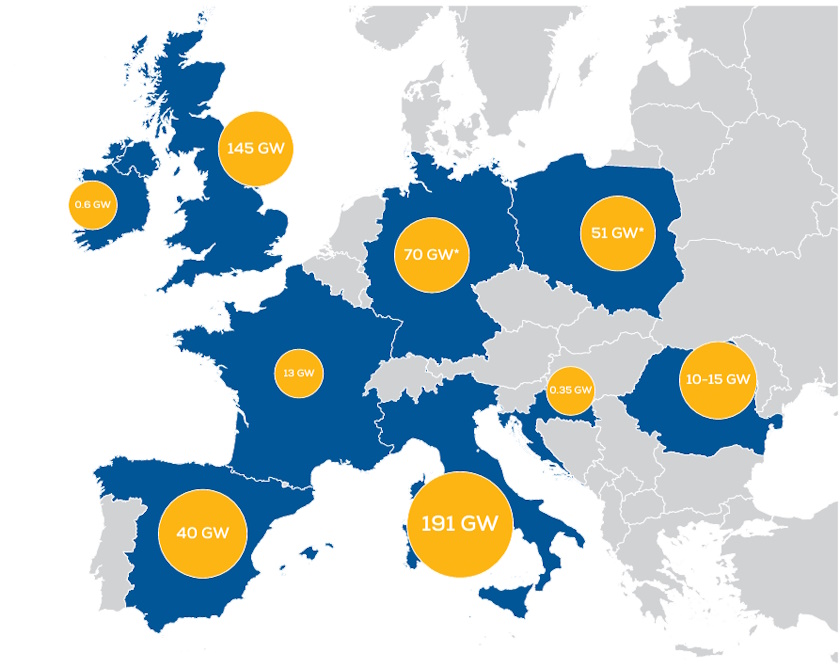
To better understand the different grid permitting and curtailment practices across Europe, WindEurope launched a survey in October 2023 to gather information from stakeholders at national levels.
The report lays out the findings from the survey and outlines what needs to be targeted:
- Efficient anticipatory planning of transmission and distribution grids. This should account for new electrified demand and renewable capacity more than 10 years ahead.
- Moving away from the first come, first served principle for granting grid access to new generation and demand.
- Accelerated implementation of EU legislation such as the revised Renewable Energy Directive (RED III) and the EU Emergency Permitting Regulation.
- Transparent harmonised rules and practices for congestion management, curtailment compensation and flexible (non-firm) grid connection agreements.
- A fair sharing of grid expansion and reinforcement costs between generation asset developers and system operators.
- Enabling grid connection rules for co-located renewables with and without storage (hybridisation) and fit for purpose revenue stabilization schemes.