

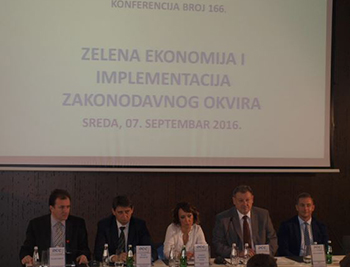
Serbia could increase its GDP by 1% with more investments into green infrastructure, according to Siniša Mitrović, Adviser to the President in the Serbian Chamber of Commerce and Industry (PKS). Speaking today at a conference in Belgrade organized by Danas Conference Center, he stated the PKS has initiated the creation of a strategy for circular economy and presented it to the country’s government.
The participants at the conference said the implementation of the Law on Environmental Protection, adopted in February, should be much better, mainly pointing out at local authorities and saying they are either not interested enough or use the so-called green money for other purposes.
Željko Ožegović, state secretary at the Ministry of Public Administration and Local Self-government, also stressed that the role of municipalities in green economy was crucial in waste management, water supply, sanitation, but also in the energy sector as producers, distributors and consumers, and that it was important they implement the law.
Serbian Environmental Protection Agency (SEPA) enabled a substantial increase in green tax income, its director Filip Radović said and added the “possibility of collection of eco-tax” soared to EUR 100 million from EUR 30 million in the last three years.
The conference also dealt with packaging and secondary waste management. Viktorija Belanović Kokir, head of Sekopak d.o.o., said her company collected and sent for recycling 180,000 tonnes of packaging and communal waste from 2010 to 2015, adding that the aim is to collect 60% of overall waste by 2019. She stressed collection and recycling helped reduce carbon dioxide emissions by 24,244 tonnes last year. Apart from managing waste, Sekopak is engaged in education of small and school children “so that they can then help the parents understand the issue,” she added.