





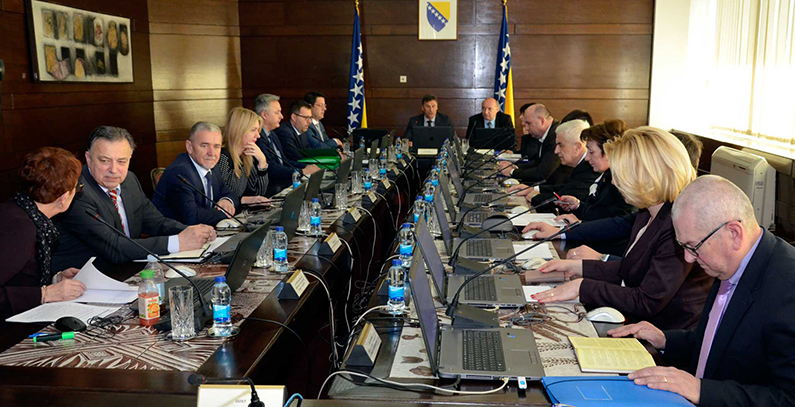
Photo: FBiH government


The Government of the Federation of BiH (FBiH) has decided to increase the surcharge paid by electricity consumers through electricity bills to fund the feed-in tariff scheme for privileged power producers. The surcharge in 2019 will be 0.002555 BAM/kWh (0.001306 EUR/kWh), up from 0.002128 BAM/kWh (0.001088 EUR/kWh) in 2018. The distribution of surcharge to privileged power producers is not planned before April 1, the FBiH Government said in a press release.
The government has also discussed the Operational Plan of the Operator for Renewable Energy Sources and Efficient Cogeneration (Operator za obnovljive izvore energije i efikasnu kogeneraciju – OIEiEK) for 2019 and instructed the financial police to conductan inspection of the Operator for OIEiEK and to deliver the report to the government by April 1.
The collected surcharge will not be distributed until the Operational Plan of the Operator for OIEiEK for 2019 is adopted, which should happen after April 1, the government said.
As a result, privileged power producers will not get BAM 18 million (EUR 9 million) in surcharge payments which have already been collected, local media reported.
The government also recommended to the Audit Office of the Institutions of the BiH to continue its activities on the audit of the Operator for OIEiEK. According to previous reports, the Audit Office had been prevented from conducting the audit of the Operator for OIEiEK.
The government has also said that the surcharge has been rising over the previous years because the FBiH is obligated to raise the share of renewable energy sources in total energy consumption and the production of renewable energy is still relatively expensive and requires incentives, as well as due to companies’ strong interest in investing in solar energy, which is an unlimited and most environmentally friendly renewable energy source.
The surcharge for 2014, 2015 and 2016 was defined by the decree and for the 0.4 kV voltage level was at 0.001 BAM/kWh (0.0005112 EUR/kWh), and in 2017 it was increased to 0.001976 BAM/kWh (0.001010 EUR/kWh). In 2019, the surcharge will be 0.002555 BAM/kWh (0.001306 EUR/kWh).
By comparison, the surcharge is 0.0075 BAM/kWh in Republika Srpska, 0.035 BAM/kWh in Croatia, and 0.0090166 BAM/kWh in Montenegro, the government said.
The surcharge is paid by all the final electricity consumers in FBiH through electricity bills.


Be the first one to comment on this article.