





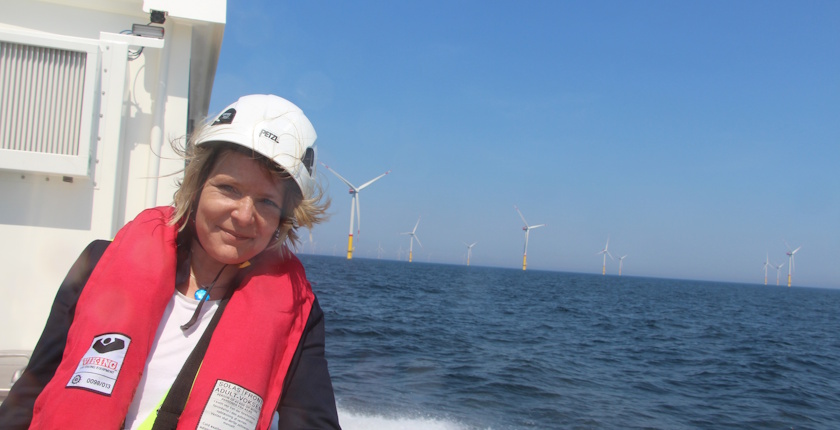
Photo: Offshore Wind Kommunikation


Author: Heike Winkler, Managing Director of Offshore Wind Kommunikation, EUSEW digital ambassador
The North Sea Summit of the North Seas Energy Cooperation (NSEC) took place in Germany at the end of January this year. Europe’s offshore wind potential is at the heart of its efforts to achieve climate neutrality, affordability and energy independence amid turbulent geopolitical conditions. This is a significant development for an energy-intensive industry such as the European steel industry, both in terms of affordable green molecules and electrons, and with regard to the EU market for the wind industry. Offshore wind energy needs green steel, and the steel industry needs energy costs that are as low and reliable as possible.
As part of the North Sea Energy Cooperation, the NSEC energy ministers, the European Commission and stakeholders met last year to set the agenda for the next 15 years of cooperation. Building on the Esbjerg and Ostend declarations, the energy ministers of Belgium, Denmark, France, Germany, Ireland, Luxembourg, the Netherlands, Norway and the United Kingdom signed a joint declaration in Hamburg to set out their ambitions of 300 gigawatts by 2050, tenders for European installation capacity of up to 15 gigawatts per year in the period 2031-2040, 100 gigawatts of cross-border cooperation projects for the North Sea, and the work of the NSEC.
Eight Baltic TSOs, organised in the Baltic Offshore Grid Initiative: 50Hertz (Germany), AST (Latvia), Elering (Estonia), Energinet (Denmark), Fingrid (Finland), Litgrid (Lithuania), PSE (Poland) and Svenska kraftnät (Sweden) published an offshore system study ahead of the NSEC summit to promote coordinated maritime spatial planning, which could become an energy hub by 2040 with around 13 GW of new interconnectors and up to 50 GW of additional offshore wind compared to 2030.
The Clean Industrial Deal takes shape
Offshore wind energy is of great importance to Europe. It is cost-effective – cheaper than building a new fossil fuel power plant. It is efficient – a single offshore wind turbine supplies 16,000 households with electricity. And it is based in Europe – it employs 100,000 Europeans. Realising the potential of offshore wind energy in the North Sea and Baltic Sea creates jobs, supplies energy and promotes industrialisation in Europe. The North Sea Summit Investment Pact will mobilise €1 trillion in economic activity and create around 91,000 additional jobs for Europe by 2031, based on the potential of the North Sea alone. So far, so good. What’s more, offshore wind provides the energy with the power plant characteristics needed to transform energy-intensive industries and stabilise electricity grids.
Moving on to the steel industry, another brief intermediate step is necessary. This involves creating a solid investment framework for offshore wind energy through targeted mechanisms such as long-term power purchase agreements (PPAs), including cross-border PPAs. PPAs enable energy-intensive companies, such as steel producers, to avoid price fluctuations by fixing the price as electricity consumers. This requires an electricity market design that is geared towards renewable energies to be able to use PPAs in the proposed manner. This is transferable to green hydrogen. And that brings us quickly to the tender criteria and the Net Zero Industry Act. But first, let’s look at the steel industry using Salzgitter AG as an example.
Transformation of energy-intensive industry using steel as an example
Salzgitter AG, as one example of a steel company in Europe, entered into strategic partnerships with developers and operators of offshore wind energy at an early stage and secured PPAs with offshore wind farms in the North Sea and Baltic Sea.
Example 1: Salzgitter AG and Ørsted are working towards closed value chains in their business relationship. In addition to the supply of offshore wind energy and the use of renewable hydrogen, this also includes the production of low-carbon steel and its use in components for Ørsted’s offshore wind farms. There are also plans to recycle scrap from wind turbines that are being dismantled in the steel production process.
Example 2: Vattenfall and the steel group are pursuing their common goal of decarbonising industrial production processes. A new PPA stipulates that fossil-free electricity from the Nordlicht 1 offshore wind farm will be available for steel production from 2028.
Example 3: Salzgitter Flachstahl GmbH and Iberdrola Deutschland have signed a long-term electricity supply contract for 2023. The electricity is to come from the Baltic Eagle offshore wind farm in the German Baltic Sea. With this PPA, Salzgitter Flachstahl GmbH has secured the supply of 114 megawatts of green electricity for 15 years.
There are other European steel producers that are undergoing sustainable transformation and require green electricity and green hydrogen for this purpose. A competitive European steel industry creates jobs in Europe and is necessary for the resilient transition to a sustainable energy supply.
And this is not a one-way street
Ilsenburger Grobblech GmbH, a subsidiary of Salzgitter AG, and wind turbine manufacturer Siemens Gamesa signed a contract last year for the supply of around 25,000 tonnes of heavy plate for the construction of 36 wind towers. The so-called ‘Siemens Gamesa GreenerTower’ has CO2eq emissions of less than 700 kg per tonne of steel per tower. RWE is testing these CO2-reduced steel towers in half of the offshore wind turbines in its Danish offshore wind farm Thor and reports a CO2 reduction of at least 63 per cent in the steel plates of the tower compared to conventional steel. In this way, the European steel industry is reducing the carbon footprint of offshore wind farms in Europe.
More aspects of decarbonisation with offshore wind power for Europe
Green hydrogen from offshore wind energy is very important for the Decarbonisation of other industrial sectors that are difficult to electrify in addition to the steel industry are: chemical industry, cement industry, maritime industry, transport, etc.
By the end of 2025, Amazon will have initiated more than 230 wind and solar projects in 13 European countries. Once all projects are operational, they are expected to provide 9 gigawatts of clean energy capacity. That is enough to power more than 6.7 million households in the EU annually. The demand is high. This is particularly true for AI and data centres in Europe.
Why the Clean Industrial Deal secures Europe
In order to enable a clean, secure and competitive energy union, the overarching theme of the 20th edition of the European Sustainable Energy Week (EUSEW), there must be fair competition and European cross-industry lead markets as described must be able to grow.
The Carbon Border Adjustment Mechanism (CBAM) and NZIA are essential for this within the framework of the Clean Industrial Deal, with a focus on resilience and climate protection. In this way, industrial transformation for greater climate protection can simultaneously achieve energy independence, increased value creation potential, jobs and thus growing prosperity for Europe. All this requires a level playing field protected from price dumping, skilled workers, European technology development, production capacities and accelerated infrastructure expansion. The necessary regulations for green hydrogen and floating offshore wind energy will accelerate the development described above. In this way, the Clean Industrial Deal will lead to growing sustainable value creation for and, above all, within Europe.
This opinion editorial is produced in co-operation with the European Sustainable Energy Week (EUSEW) – the biggest annual event dedicated to renewables and efficient energy use in Europe. #EUSEW2026 marks the 20th edition and will once again bring together the community of people who care about building a secure and clean energy future for the next generations.
Check the currently open calls to join.
Disclaimer: This article is a contribution from a partner. All rights reserved.
Neither the European Commission nor any person acting on behalf of the Commission is responsible for the use that might be made of the information in the article. The opinions expressed are those of the author(s) only and should not be considered as representative of the European Commission’s official position.



Be the first one to comment on this article.