

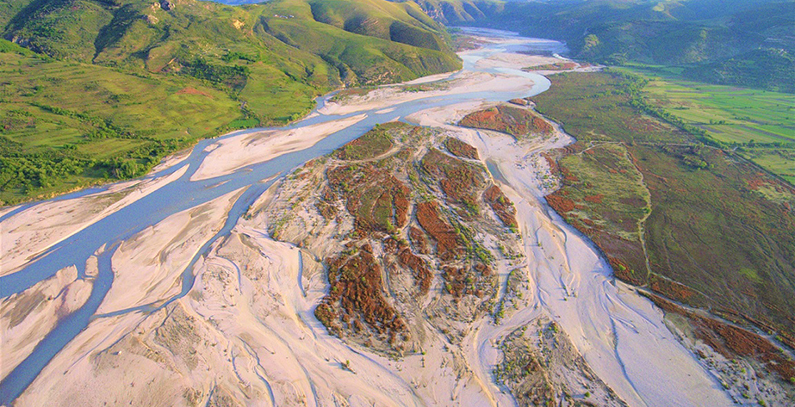
EcoAlbania, Riverwatch and EuroNatur have sent a complaint to the Energy Community (EnC) against the Albanian Government over procedures for the Kalivac and Pocem hydropower projects. The three civil society organizations behind the campaign for the protection of the Vjosa River have raised concerns that the procedures for the two hydropower plants (HPPs) are not in line with EnC rules.
According to Riverwatch’s press release, this is the first time a complaint has been filed with the Energy Community regarding hydropower projects in Albania.
The complaint addresses violations of the EU Environmental Impact Assessment Directive (EIA) related to the hydropower projects Kalivac and Pocem. The EIA Directive is an integral part of the EnC’s regulatory framework.
“Furthermore, both the company and public authorities failed to meet public consultation requirements. The complaint is emphasizing the evident infringements of Energy Community rules,” Riverwatch said.
Olsi Nika from EcoAlbania noted that this is another step in their long fight against the hydropower projects on the Vjosa River.
“We are convinced that the Albanian Government is breaking not only Albanian law but also its commitment to the EnC. The two HPPs are not even economically viable, as social and environmental costs are underestimated,” she said.
Ulrich Eichelmann of Riverwatch expects the Energy Community to start an infringement procedure against Albania within the next six months. He hopes that the dam projects would have to be stopped.
The investor in EUR 125 million Kalivac HPP is the joint venture Ayen-Alb, a consortium of Albania’s Fusha and the Turke’s Ayen energi, while the investor in EUR 160 million Pocem HPP are Turkish companies Ayen Enerji Sirketi Anonymous and Cinar-San Hafriyat Nakliyat Turizm Insaat San Ve Tic, the three organizations said in a complaint.
The campaign “Save the Blue Heart of Europe” aims to protect the most valuable rivers in the Balkans from a tsunami of about 2,800 dam projects.
A few days ago in Podgorica, Western Balkan countries once again confirmed their ambition to encourage decarbonization, renewables, and energy efficiency.
But, at the same meeting Johannes Hahn, European commissioner for enlargement negotiations and neighborhood policy, warned these countries that the construction of HPPs must be in line with the sustainable development principles and the future EU requirements for countries in the region.