


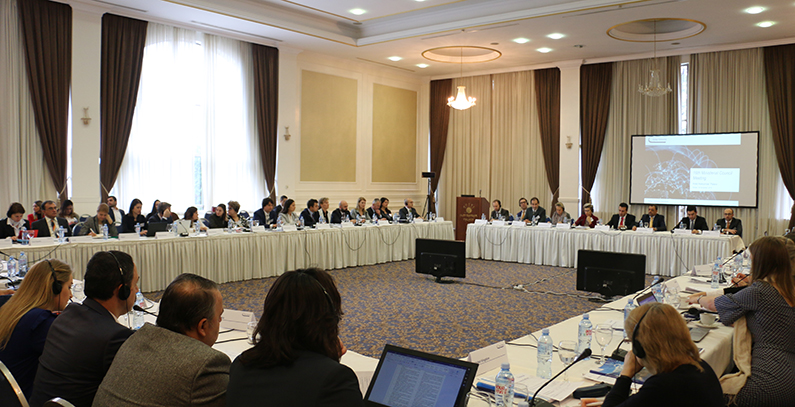
Energy Community Ministerial Council, held today in Skopje, took some key decisions, including the adoption of General Policy Guidelines on 2030 energy and climate targets, the selection of 21 infrastructure projects of regional significance, and re-opening of the negotiations on amendments to the Treaty establishing the Energy Community.
The meeting, which brought together ministers of energy as well as environment, also prolonged the mandate of Janez Kopač as Director of the EnC Secretariat for the next three years beginning on 1 December 2018.
The Council agreed to incorporate in 2019 the revised Energy Efficiency Directive and Renewable Energy Directive and new Governance Regulation with 2030 targets for Contracting Parties in the Energy Community.
The Council also took a decision to expand the EnC acquis by adopting new Energy Labelling Regulation 2017/1369 and Regulation No 1227/2011 on wholesale energy market integrity and transparency (REMIT).
“The General Policy Guidelines on 2030 energy and climate targets recognizes the need to establish targets on energy efficiency, renewable energy sources and greenhouse gas emission reduction. The targets should be in line with the EU targets for 2030, represent an equal ambition for the Contracting Parties and take into account relevant socio-economic differences, technological developments and commitments under the Paris Agreement on Climate Change,” the Secretariat’s press release reads.
Serbia, BiH get extra 6 months to comply with EnC acquis
According to Secretariat, the 8 Projects of Energy Community Interest and 13 Projects of Mutual Interest adopted under Regulation 347/2013 on Guidelines for Trans-European Energy Infrastructure will benefit from investment incentives and enhanced regulatory conditions.
In the electricity sector, the Trans-Balkan corridor will connect Bosnia and Herzegovina, Montenegro, Serbia and Romania and the rest of the Western Balkans with the Italian power system over an undersea cable.
The Ministers took decisions on a number of dispute settlement cases establishing a serious and persistent breach under Article 92 of the Treaty. These include BiH, Serbia and Ukraine for failure to comply with the Sulphur in Fuels Directive and BiH for not transposing the Third Energy Package.
As regards Serbia’s lack of compliance related to revenues from the allocation of cross-border capacity on certain interconnectors, the breach will only be considered serious and persistent if it is not solved within the next six months. The Council decided to grant BiH another six months before new measures take effect in relation to gas legislation.