


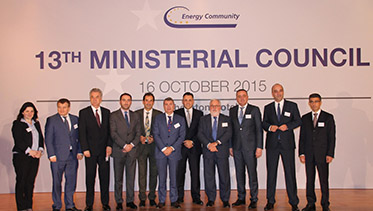
The 13th Energy Community Ministerial Council took place today in Tirana under the Albanian presidency in office of the Energy Community. A study on progress in renewable energy and assessment of action plans was published.
European commissioner for climate action and energy Miguel Arias Cañete, representing the European Union at the meeting, said: “The Energy Community is the most efficient instrument in ensuring effective implementation of the EU’s energy, environment and competition acquis in the European Union’s neighbourhood. Today’s Ministerial Council once again took key steps to achieve closer integration of the EU and Energy Community energy markets in a sustainable way. Today’s adoption of a 20% energy efficiency target puts the contracting parties on par with EU member states. Moreover, the adoption of the TEN-E regulation lays down the foundations for a truly pan-European energy infrastructure system.”
Albanian Energy Minister Damian Gjiknuri said: “I am delighted that Albania was able to deliver on its presidency priorities in terms of adoption of new laws and the implementation of the Third Package, building the new pan-European Energy Union. Today we have also adopted concrete reforms and a roadmap for the future in line with the recommendations of Jerzy Buzek’s High Level Reflection Group. The Energy Community needs reform in order to tap its full potential, and I am very satisfied that this process has begun.”
Directive 2012/27/EU on Energy Efficiency adopted by the council establishes a framework of measures for the promotion of energy efficiency within the Energy Community, setting a 20% target by 2020, and paving the way for further improvements beyond.
For the first time, the Ministerial Council adopted sanctions – against Bosnia and Herzegovina, for its failure to adopt the Second Energy Package in the gas sector. The measures will be applicable for a period of one year.
The Energy Community Secretariat published a study on progress in renewable energy in 2013 and 2014 and assessment of renewable energy action plans. Three contracting parties (Bosnia and Herzegovina, Former Yugoslav Republic of Macedonia and Albania) have not adopted an action plan yet. The analysis identified inconsistencies in the data reported with official energy statistics, mostly related to biomass consumption in some contracting parties. A revision of energy statistics based on energy consumption surveys is needed, the organization’s press release said.
The heating and cooling and transport sectors are severely lagging behind. All parties except Montenegro are at least slightly below the trajectory for meeting the 2020 renewable energy targets in 2020, but the lack of progress in Moldova, Serbia and Kosovo* is most critical. In certain countries a revision of the renewable energy policies is urgently needed, the Energy Community said.
Apart from introducing attractive support measures, the legislative framework is still not conducive to investments in renewable energy, which is reflected among others in the improper formulation of power purchase agreements. Biofuels sustainability criteria and establishment of certification schemes have not been adopted in any contracting party, the statement said.