








Photo: Freepik


Author: Thomas Nowak, EUSEW digital ambassador
Almost half of the European Union’s population lives in multi-family buildings, which are often energy-inefficient and still dependent on fossil fuels. In this opinion piece, Thomas Nowak, EUSEW Digital Ambassador, argues that solutions for decarbonising these buildings already exist, from heat pumps to modernised district heating, but that wider deployment will require a clearer and faster regulatory framework.
Almost half of all EU citizens – roughly 200 million people – live in flats according to Eurostat, with the highest level in Spain and Latvia (around 65%). The majority of urban residents in central and eastern Europe live in multi-family buildings, which means large prefabricated blocks from the 1950s to the 1980s featuring, in too many cases, minimal insulation, ageing district heating or central gas boilers, and an energy bill that too often dominates household budgets.
The scale of the challenge is clear. Buildings account for 40% of total EU energy consumption; about 80% of household energy goes to heating, cooling and hot water. Some 85% of the building stock pre-dates the year 2000, and three-quarters of it is classified as energy-poor. The annual renovation rate sits at barely 1%. At this pace, the essential contribution of a decarbonized building stock to the EU’s climate goals cannot be achieved.
The legislator has understood
All types of buildings are covered in the revised Energy Performance of Buildings Directive (EPBD). It’s in force since May 2024 and sets a binding residential trajectory: the worst-performing 16% of the stock must be renovated by 2030, the worst 20–22% by 2035, and all fossil fuel boilers are to be phased out by 2040. Incentives for stand-alone fossil boilers had to be withdrawn by 1 January 2025.
The revised Energy Efficiency Directive (EED) specifically requires transparent cost-allocation rules for multi-apartment buildings with collective heating systems – a direct tool against the split-incentive problem between landlords and tenants.
And from 2028, the EU Emissions Trading System for buildings (ETS2) will put a direct carbon price on fossil heating, making continued gas boiler operation structurally more expensive with every passing year.
“No solutions exist for multi-family buildings” – a myth worth retiring
In the debate around the heating transition, a stubborn narrative frames multi-family buildings as a special problem that current technology cannot solve. The usual prescription: keep using gas, wait for green hydrogen or biomethane, or connect to district heating if you happen to be lucky enough. This narrative is factually wrong.
Solutions exist for investors in need of change
Five categories of clean heating solutions are commercially available today, proven in deployment, and applicable to the full range of the European multi-family building stock. They create the foundation for a multitude of alternatives, considering that all of them can cover the full energy demand either as stand alone or hybrid solutions, combining more than one technology. In consequence stand alone fossil boilers can be removed from every type of building.
Table one compares the options.
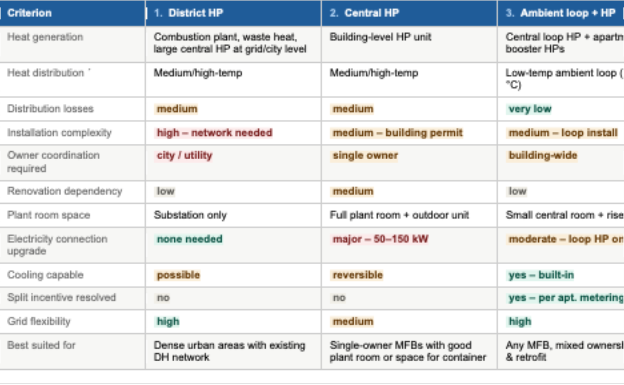
- District heating with a central heat pump. Where a network exists or is being built, connecting buildings to it is often the lowest-complexity path for the building-owner. The greening of existing and new grids can be accomplished by the deployment of large heat pumps extracting heat from river or groundwater, sewage systems or industrial waste heat at high efficiency. No building-level plant room upgrade is needed; the electrical load sits at grid level rather than building level.
- Central building heat pump (air or ground source). A direct one-to-one replacement for the central boiler, feeding the existing hydronic distribution system. Often requires a plant room upgrade, space for an outdoor air unit or ground boreholes, and a building-level electricity connection upgrade. If outdoor space is available, the plant room can also be established in a separate heat container. Depending on the energetic quality of the building, a radiator replacement or an update of the thermal envelope maybe necessary to enable lower flow temperatures (around 55°C or less).
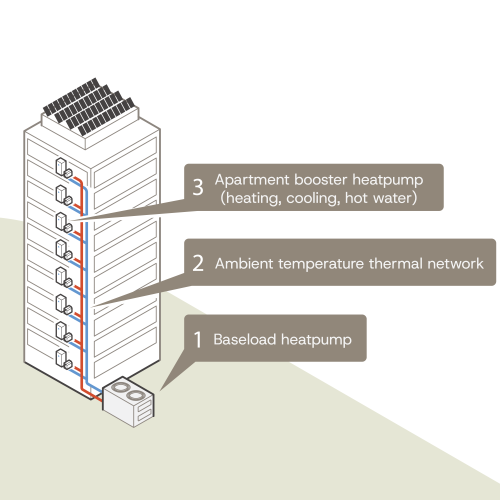
- Building ambient loop with apartment heat pumps – the 1-2-3 solution (see illustration). A shared low-temperature loop circulates water through the building. Individual compact heat pumps in each apartment extract or reject heat to the loop for heating, cooling and hot water. The loop’s base temperature is maintained by a central heat pump, photovoltaic-thermal collectors or shallow geothermal. Because each tenant controls and meters their own unit, the split-incentive problem is structurally resolved. This is a very promising solution for apartments with individual gas boilers. As energy circulates at ambient level, thermal losses are minimized.
- Fully decentralized apartment heat pumps. Air-to-air splits, small air-to-water units, exhaust air heat pumps and window heat pumps allow individual apartments to act independently. No building-wide coordination is needed. In most Member States, installation requires no building permit and can be completed in a single day. Particularly suited to condominiums with fragmented ownership. However uncoordinated deployment may create an eye sore on the façade, lead to higher noise emissions and may stress the electric grid of the building.
- Direct electric heating. In near-passive or well-insulated buildings, electric infrared panel heaters, immersion hot water storage or instantaneous hot water heaters combined with on-site PV and batteries provide a simple path to decarbonisation. Also valuable as a peak-load top-up in any of the systems above, reducing the required heat pump capacity and capital cost.
Info box
Decarbonising multi-family buildings with ambient loops, base load and booster heat pumps: as easy as one – two – three
1. A central heat pump provides the thermal energy to the ambient-loop
2. A shared ambient loop circulates that energy through the building, collecting waste heat and connecting all apartments to a common thermal resource.
3. A compact booster heat pump in each apartment lifts the loop temperature to meet individual heating, cooling and hot water needs – giving each resident control and metering.
Beyond decarbonisation: clean air and grid services
Replacing gas and oil boilers with heat pumps eliminates on-site combustion, directly reducing the NOₓ and fine particulate emissions that cause urban air pollution and respiratory diseases. In the case of ambient temperature thermal networks, the reduction of heat islands comes as an additional benefit, as waste heat from summer cooling is collected and made available for other users.
Thermal networks and thermal buffer tanks serve as storage that can shift consumption to periods of abundant, cheap renewable electricity – acting as virtual batteries in the electricity system. This demand-side flexibility is already being rewarded through dynamic tariffs in several Member States, and its value will grow as Europe’s power system takes on more variable renewables.
Conclusion
The solutions for decarbonising multi-family buildings are commercially available, technically proven, and deployable today across the full diversity of the European building stock. What is still missing is the economic framework that makes investments attractive: the rapid and ambitious implementation of the EPBD renovation mandates, the EED split-incentive rules, and the ETS2 carbon price signal at national level is what will turn today’s available technology into tomorrow’s renovated buildings.
This opinion editorial is produced in co-operation with the European Sustainable Energy Week (EUSEW) – the biggest annual event dedicated to renewables and efficient energy use in Europe. #EUSEW2026 marks the 20th edition and will once again bring together the community of people who care about building a secure and clean energy future for the next generations.
Check the currently open calls to join.



Be the first one to comment on this article.