


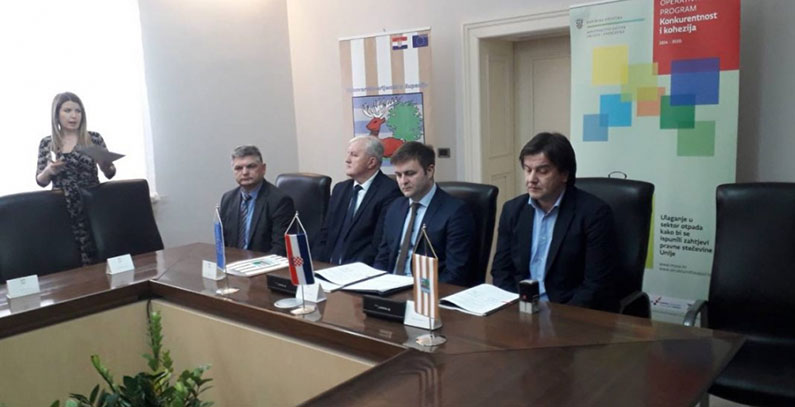
Croatian municipalities Nuštar, in Vukovar-Srem County, and Kneževi Vinogradi, in Osijek-Baranja county, have received the European Union (EU) grants for the construction and equipping of recycling yards.
Croatia’s minister for environment and energy and chairpersons of Nuštar and Kneževi Vinogradi municipalities signed a contract on EU grants for these projects, secured from the Cohesion Fund for the 2014-2020 period. The EU participation is 85 percent of the eligible costs of the projects.
Croatia’s minister for environment and energy Tomislav Ćorić met last week with representatives of the counties and local self-governments in this region of Croatia in order to discuss waste management in the area. He emphasized that the construction of recycling yards is merely one segment in the establishment of solid waste management system.
The total value of the construction and organization of the Nuštar recycling yard amounts to HRK 3.289.569,85 (EUR 442.500), of which 85% covers the EU (EUR 376,100), according to the Ministry statement.
For Kneževski Vinogradi recycling yard HRK 1,898,562.50 (EUR 255,000) has been allocated, with EUR 217.000 (85 percent) contribution. With this recycling yard, residents will be able to dispose all types of waste free of charge.
In January 2017. Croatian government adopted a 5-year Waste Management Plan. That document was a precondition for obtaining the funding from the European Union for the implementation of operational plan “Competition and Cohesion”.
Croatian Ministry of Environmental Protection and Energy in April 2017 announced the first public call for waste management projects to be co-financed from EU funds. The grant worth EUR 19.4 million was announced to be used for the construction of recycling yards.
Ministry’s goal is to increase the separation rate of collected communal waste and to reduce the quantity of waste dumped at the landfills. According to the EU’s Waste Framework Directive, Croatia is expected to reach a separation rate of 50% by 2020, including glass, plastic, paper and metal.
It is estimated that in 2014, Croatia’s waste recycling rate was 16%. In that year EU’s average recycling rate was 44%, and the goal is to reach 50% by 2030.