





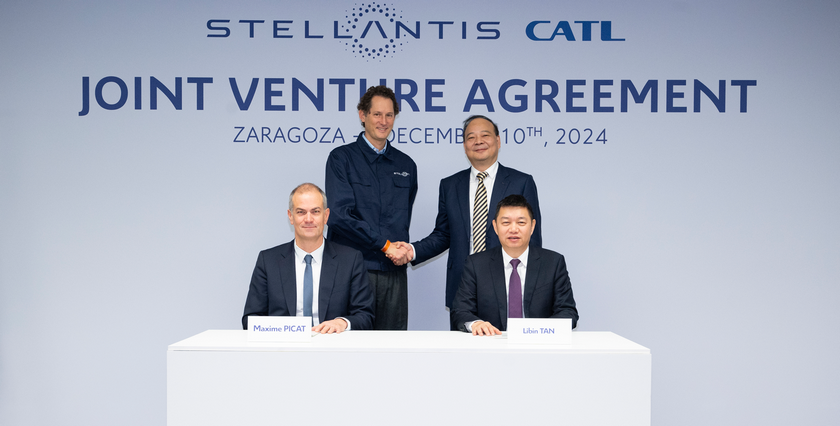
Photo: Stellantis


Carmaker Stellantis and Chinese battery producer CATL have agreed to jointly invest EUR 4.1 billion in a large-scale factory in Spain to produce lithium iron phosphate (LFP) batteries. The carbon-neutral plant, targeted to start production by the end of 2026, is expected to be one of the largest manufacturing facilities in Europe for electric vehicle (EV) batteries.
Located at Stellantis’ Zaragoza site in northeastern Spain, the future LFP battery plant could reach a capacity of up to 50 GWh per year, depending on the evolution of the EV market in Europe and further support from the Spanish and European authorities, according to a press release from Stellantis.
The project comes as European automakers are seeking full electrification amid a number of challenges, such as a lack of affordable models and a slow rollout of EV charging points. Stellantis has received subsidies from the Spanish government under its EUR 5 billion plan to attract EV and battery manufacturers to the country, according to reports.
Stellantis has received subsidies from the Spanish government
Stellantis Chairman John Elkann has said the collaboration with Contemporary Amperex Technology Ltd. (CATL) will bring innovative battery production to a manufacturing site that is already a leader in clean and renewable energy, and he thanked the Spanish authorities for their continued support.
The project is to be developed in phases by a 50-50 joint venture between Stellantis and CATL. The transaction is expected to close during 2025 subject to regulatory conditions.
The plant will boost Stellantis’ best-in-class LFP offer in Europe and enable the automaker to offer more high-quality, durable and affordable battery-electric passenger cars, crossovers, and SUVs in the B and C segments with intermediate ranges, reads the press release. Stellantis was created through a merger of Italian-American firm Fiat Chrysler Automobiles and the French PSA Group.
The Chinese company already has two battery plants in Germany and Hungary
CATL, one of the world’s biggest battery producers, has brought state-of-the-art battery manufacturing technology to Europe through its two plants in Germany and Hungary, which are already operational, reads the statement, adding that the Spanish facility will enhance CATL’s capabilities to support customers’ climate goals.
The two companies signed a non-binding memorandum of understanding in November last year for the local supply of LFP battery cells and modules for EV production in Europe, the press release recalled.

Be the first one to comment on this article.