


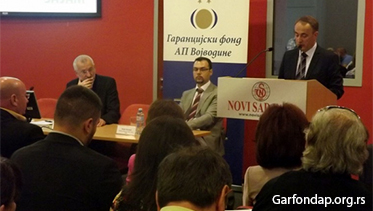
Guarantee Fund of Vojvodina, Serbia’s northern province, organized an international conference named ’Promoting Renewable Energy Sources: Biomass in Agriculture’ in partnership with Heinrich Böll Foundation, German International Cooperation – GIZ, and European Affaires Fund of Vojvodina, under patronage of the Provincial Secretariat for Energy and Mineral Resources, and with support from the Provincial Secretariat for Economy, Employment and Gender Equality. The aim of the event, part of 82nd International Agricultural Fair, was to show the significance of biomass potentials’ sustainability and ways to increase the share of renewable energy sources usage, by presenting data on expenses and benefits of biomass utilization in Europe. Guarantee Fund of Vojvodina presented its credit lines which will be employed in cooperation with five banks in Serbia.
Opening the conference, the provincial government’s vice premier Miroslav Vasin stressed Vojvodina is a region rich in biomass, and added this is the energy source with the biggest potential, but that there are cases of people burning their fields, thus destroying vast resources.
Nenad Stanković, energy and mineral resources secretary, said Serbia should and has to follow the examples of developed countries in the field of renewable sources, them being an important energy factor in the world, in the environmental aspect as well as for savings from energy imports, considering Serbia was dependent on them for 50% of its needs.
Andreas Poltermann, Heinrich Böll Foundation’s Belgrade office chief, said joining efforts i. e. cooperation in the renewable energy sources area is important for a sustainable future and expressed satisfaction at banks in Serbia being prepared to support projects in the sector.
Serbia is obliged, as a member of the Energy Community, to implement rules on renewable energy sources. Karolina Čegir, gas and biofuels expert from the Energy Community Secretariat, explained that in Serbia energy is produced from two kinds of renewable sources – wood for heating and hydropower, and that the state has to abolish administrative and regulatory barriers to accomplish goals concerning the increase of utilization and other renewables.
Thomas Mitschke from GIZ, German international cooperation agency, spoke of the organization’s logistical support to altering the renewable sources sector in Serbia, and particularly stressed the area of biomass and the country’s potentials for it in agriculture.
Hermann Wieser, CEO of Austrian Agricultural Cluster, presented numerous examples of biomass utilization’s benefits and underscored that it is a sustainable product that does not pollute and is cheaper than fossil fuels. This association of companies active in foreign trade offers solutions through the whole food chain and it cooperates with the University for Agricultural Sciences Vienna (BOKU), University of Veterinary Medicine Vienna, with ministries (www.lebensministerium.at), the Austrian Chamber of Commerce and local European Union offices in Eastern and Southeastern Europe.
Vojislav Milijić, president of Serbio, National Biomass Association of Serbia, presented the project for establishing logistical wood biomass centres in Serbia, Croatia and Bulgaria, and stressed how increased biomass use means greater energy independence.
Ecopanonia cluster, presented by József Kunos, aims to connect everyone who participates in projects for renewable energy sources utilization, with an emphasis on owners of small farms.