





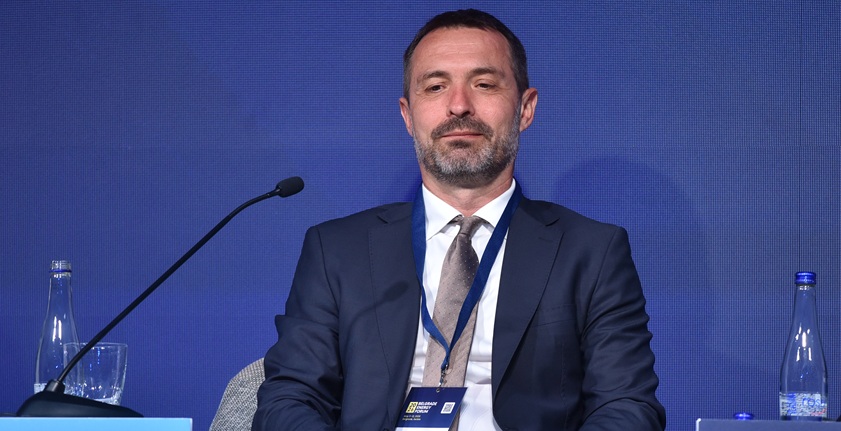
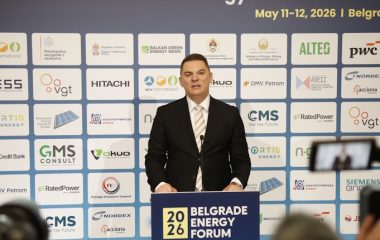
Ivan Asanović (photo: Balkan Green Energy News)


Montenegro expects that the European Commission will verify the country’s transposition of the Electricity Integration Package by the end of June, paving the way for market coupling with the European Union in early 2028, Ivan Asanović, CEO of Montenegro’s transmission system operator, Crnogorski Elektroprenosni Sistem (CGES), said at Belgrade Energy Forum 2026 (BEF 2026).
Montenegro could thus become the second Energy Community contracting party, after Serbia, to secure verification of its transposition of the Electricity Integration Package (EIP).
The verification is a prerequisite for integrating the national electricity market with the EU’s. Market coupling is being implemented by Energy Community contracting parties, including Albania, Bosnia and Herzegovina, Kosovo*, Montenegro, North Macedonia, and Serbia.
Following the adoption of EIP, a two-step verification process begins. The transposition is first verified by the Energy Community Secretariat, and then by the European Commission.
The verification process began on March 3
Artur Lorkowski, Director of the Energy Community Secretariat, has said the European Commission is expected to issue its opinion on compliance for Serbia by May 16.
Montenegro, for its part, hopes to receive it by the end of June, according to CGES CEO Ivan Asanović.
Asanović, who participated in the panel on transmission grid development at BEF 2026, told Balkan Green Energy News that the verification process for Montenegro started on March 3.
In about five to six months, the secretariat and the commission should issue an opinion, he added.
Market coupling would be possible in early 2028
“It would be very significant for us if the opinion were to be issued by June, because we could officially start the local implementation project (LIP) for market coupling. From then on, there is an 18-month period, a phase in which technical activities are carried out, and we can seize the “first window” and couple in early 2028,” Asanović stressed.
He explained that once two countries planning to merge their markets – in this case, Montenegro and Italy – establish cooperation, they need to adopt operational rulebooks, procedures, and methodologies, which are highly technical activities.
“There is a lot to do to synchronise this, and that’s why the 18 months,” he added.
According to Asanović, CGES, Italian TSO Terna, and the energy regulators of the two countries have already prepared some of the steps envisaged in the 18-month period, which will make their work easier.

Be the first one to comment on this article.