







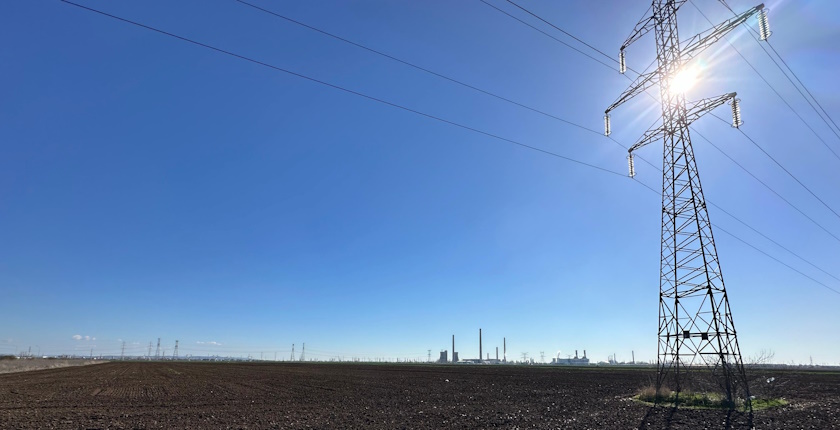
Photo: El-Mor


Romania’s grid-scale energy storage market is moving quickly from development to execution, and time-to-market is emerging as the key differentiator. Against this backdrop, El-Mor Electric Installations & Services is advancing two large stand-alone Battery Energy Storage System (BESS) projects designed for rapid delivery: BRADU BESS (Argeș) and BRAZI BESS (Prahova).
Each project targets 203 MW with up to 800 MWh of energy capacity (4-hour duration) and is planned to connect at 110 kV to substations operated by Romania’s transmission system operator, Transelectrica. Both already hold an ATR (technical connection approval) and are on track for full RTB (ready-to-build) in Q1 2026, with a clear pathway toward commissioning in H1 2027, subject to investor execution and financing.
As Romania’s BESS market quickly expands and evolves from speculative development to “delivery phase,” many projects may appear similar at first glance. What increasingly separates bankable opportunities from speculative pipelines is execution certainty: connection clarity, mature permits, optimized connection CAPEX, and documentation that can withstand lender-grade due diligence.
El-Mor’s development approach is built around de-risking the elements that typically delay BESS projects – particularly the grid interface and permitting quality – so an investor can move fast with fewer late-stage surprises.
Quality control, risk management, bankability
El-Mor Electric Installations & Services is a public company listed on the Tel Aviv Stock Exchange, reporting over €200 million in 2025 sales. Through its PV and BESS project activity, the company emphasizes an engineering-led approach and decades of high-voltage experience, underpinning a development practice focused on quality control, risk management, and overall bankability of each permitting package.
A core theme in El-Mor’s development approach is technology flexibility. The projects are permitted on an equipment-agnostic basis, allowing an investor to select BESS containers and Power Conversion System (PCS) technology at the detailed design phase. This matters because equipment availability, pricing, and lender bankability requirements can shift, and a project able to adapt without reopening permits is better positioned to preserve schedule.
Second project to become ready before end-March for construction start
BRADU BESS is a 203 MW / up to 800 MWh project in Bradu commune (Argeș), connecting to Transelectrica’s BRADU 400/220/110 kV substation. Its underground 110 kV cable route is approximately 0.6 km, supporting both schedule and connection cost optimization. El-Mor notes that building permits were issued in January 2026, with GCA (Grid Connection Agreement) signature targeted for March 2026.
BRAZI BESS is a 203 MW / up to 800 MWh project in Brazi commune (Prahova), planned to connect to Transelectrica’s BRAZI 400/220/110 kV substation via an underground 110 kV cable route of approximately 1.2 km. Development was initiated in 2023, and the project is on track for full RTB in Q1 2026.
In a market where speed of execution and certainty have become essential investment criteria, “delivery-ready” only matters if it survives rigorous due diligence. El-Mor’s positioning emphasizes disciplined VDR management and a permitting package engineered to keep options open while enabling fast execution.

Be the first one to comment on this article.