







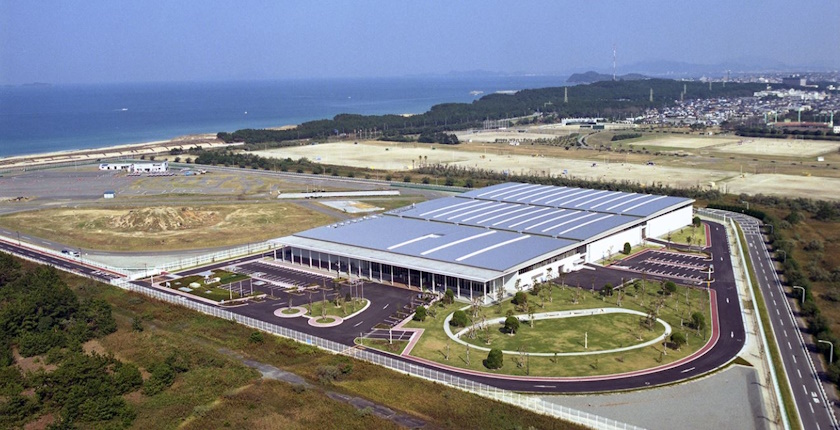
Uminonakamichi Nata Sea Water Desalination Center (photo: Obayashi)


Japan’s first osmotic power plant began operations in early August. The facility in Fukuoka harnesses the natural process of osmosis.
Operated by the Fukuoka District Waterworks Agency, this is only the second such commercial plant in the world, according to Science Japan. The first plant, commissioned by Danish firm SaltPower in 2023, is located in Mariager, Denmark.
The agency estimates the plant will generate 880,000 kilowatt-hours annually. The electricity will be used to power a local desalination facility, providing a sustainable energy source for the region’s freshwater supply.
A next-generation renewable energy source unaffected by weather or time of day
It is “a next-generation renewable energy source that is not affected by weather or time of day and emits no carbon dioxide,” according to the Fukuoka District Waterworks Agency.
The facility utilizes the salinity difference between fresh and saltwater to generate energy. This difference causes water to move across a semipermeable membrane from freshwater to saltwater, balancing the concentration on both sides.
Electricity is produced by using a permeable membrane to separate concentrated seawater from treated freshwater sourced from a local sewage treatment facility. The membrane allows only water molecules to pass through it.
Expert: This successful implementation is a major achievement
The pressure created as freshwater moves through the membrane toward the saltwater side spins a turbine, which in turn powers a generator to produce electricity.
According to Akihiko Tanioka, an expert in the field, this successful implementation is a major achievement. He hopes it will be replicated globally.
Apart from the two osmotic power plants in Japan and Denmark, pilot-scale projects and prototypes are being implemented in Norway, South Korea, Australia, Spain, and Qatar, according to a report by the Guardian.
The Japanese plant marks an exciting moment for osmotic power, because it offers further proof that the technology can be used for large-scale energy production, according to the news outlet.




Be the first one to comment on this article.