







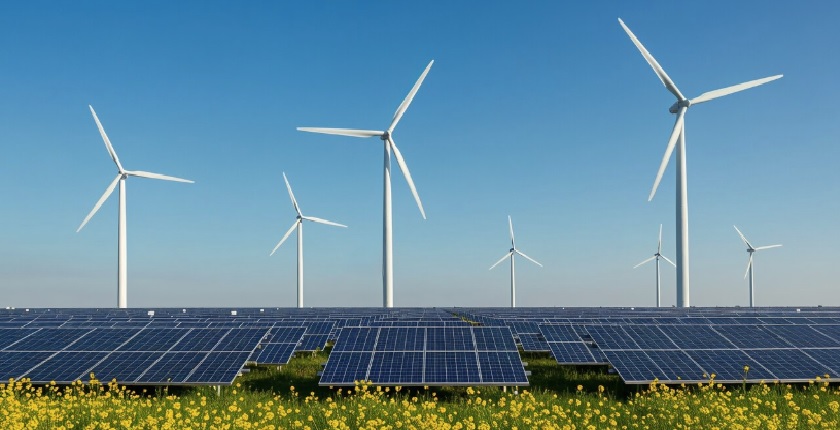
Photo: freepik.com


Greece’s special account for renewables, which covers support payments to renewable energy producers, turned positive again in 2024 after years of instability.
The account is currently manageable, according to data from the Renewable Energy Sources Operator & Guarantees of Origin (DAPEEP). The update is bringing certainty to the market and reassures investors that their power plants won’t come up short.
For the end of 2025, initial projections show a deficit of EUR 173 million, which would be covered by a EUR 70 million reserve and proceeds from the taxation of diesel sales.
Lower wholesale prices reduce income
However, DAPEEP’s leadership is concerned about the future balance. The reason is the effect of zero or negative wholesale power prices as they are becoming more common than before.
In the trading session for May 1 on the day-ahead market of the Hellenic Energy Exchange (HEnEx), a record low hourly price was registered, EUR 50 per MWh below zero. The event occurred amid high solar production in combination with low demand on a holiday, and similar conditions in neighboring markets. The authorities are expected to allow the formation of negative prices in the balancing market, starting in June. It is expected to lead to more common zero and negative prices.
Low market prices harm the special renewables account, according to DAPEEP’s new CEO Dimosthenis Voivontas. Consumers benefit in such situations but they reduce income for the operator.
So far, the exact effect of negative prices remains to be seen, as there is limited data to analyze. Nevertheless, energy storage must be brought online quickly, together with demand response capabilities, says Viovontas.
Producers switch off to avoid negative prices
Negative hourly prices have led producers to switch off their renewable energy plants lately in order to avoid a financial loss. It is making it more difficult for the Independent Power Transmission Operator (IPTO or ADMIE) to conduct daily scheduling. The authorities are worried that a sudden disconnection of large capacities could result in instability, in light of the recent blackout in Spain and Portugal.
The focus is on aggregators, which represent groups of renewable electricity facilities in the market. Currently they lack the means to completely control their production in real time. Discussions are underway about a mutually acceptable solution.

Be the first one to comment on this article.