






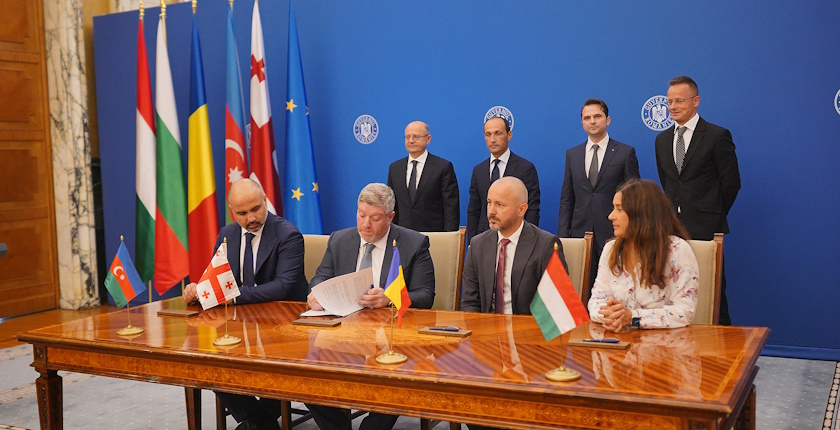
Photo: Georgian State Electrosystem


Romanian transmission system operator Transelectrica, Georgian transmission system operator Georgian State Electrosystem, Azerbaijan’s power utility AzerEnerji, and Hungary’s power utility MVM have established a joint firm to install a submarine cable under the Black Sea.
The four parties have signed a shareholders’ agreement on the launch of Green Energy Corridor Power Company, according to media reports. The ceremony was held in Bucharest during the 8th Ministerial Meeting of the Green Corridor project.
Romania’s Ministry of Energy said the project firm would be based in Romania.
It will oversee the implementation of the Green Corridor project, which envisages a high-voltage direct current (HVDC) interconnector under the Black Sea, the update adds.
A cable that would first connect Romania and Georgia would be extended to Hungary and Azerbaijan. The interconnection is envisaged to link the transmission networks of the four countries and facilitate the flow of renewable electricity.
The project would diversify supply sources
Of note, the four countries signed an agreement that formalized the project back in December 2022. The European Network of Transmission System Operators (ENTSO-E) included the Black Sea interconnector in its plans. Georgia estimated that the project would cost more than EUR 2 billion. It expects the link to become operational by late 2029.
The Romanian ministry pointed out that the cable would enhance national and regional energy security, increase connectivity in the Black Sea basin, diversify supply sources, harness the potential for renewable energy production, and increase the share of renewable energy in the national energy mix.
Minister of Energy Sebastian Burduja highlighted the project’s importance for Romania and the European Union.
The first results of the feasibility study are set to be presented at COP29 in Baku
The project will also contribute to the decarbonization of the energy sector, mainly by transporting renewable energy, Burduja said.
He added that the first results of the feasibility study would be presented in November in Baku, Azerbaijan’s capital, at the 2024 United Nations Climate Change Conference COP29.
The representatives of Azerbaijan, Georgia, Hungary, and Romania signed a protocol to amend the initial agreement. It clarifies that EU legislation and the obligations arising from Romania and Hungary’s membership prevail over the provisions of the contract.
They also discussed the possibility of Bulgaria joining the feasibility study and the project, the ministry added.


Be the first one to comment on this article.