






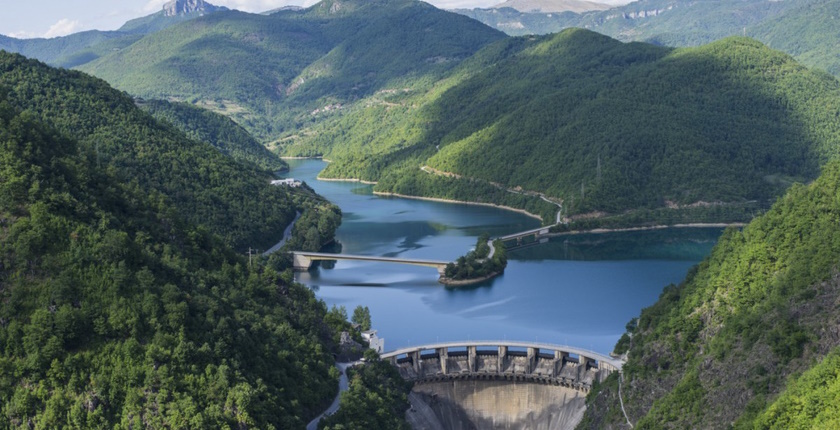
HPP Jablanica (photo: EPBiH)


Share


Share
State-owned power utilities Elektroprivreda Bosne i Hercegovine (EPBiH) and Elektroprivreda Hrvatske zajednice Herceg Bosne (EPHZHB) have posted their results for the first half of 2023, with EPBiH reporting a loss and EPHZHB logging a profit.
Both EPBiH and EPHZHB are owned by the Federation of BiH, one of the two political entities of Bosnia and Herzegovina (BiH). The third power utility in BiH, Elektroprivreda Republike Srpske (ERS), owned by the Republic of Srpska, has not yet posted its H1 results.
In the first six months of 2023, EPBiH’s revenues fell by BAM 50 million (EUR 25.6 million) against the same period a year earlier, to BAM 593 million (EUR 303.9 million), while expenditures decreased by BAM 26 million (EUR 13.3 million), to BAM 618 million (EUR 316.5 million).
The bottom line was a loss of BAM 24.5 million (EUR 12.5 million), according to the company’s H1 financial report. In 2022, EPBiH posted a profit of BAM 219,000 (EUR 112,000).
The lower revenues, according to the EPBiH management, were mainly due to falling electricity prices, but total electricity sales were also well below target.
On the other hand, EPHZHB had revenues of BAM 247 million (EUR 126.5 million), and expenditures of BAM 194 million (EUR 99.4 million), with revenues rising by BAM 39 million (around EUR 20 million) and expenditures by BAM 106 million (EUR 54.3 million) year-on-year.
This resulted in the company’s profit rising from BAM 19.7 million (EUR 10.1 million) to BAM 53.6 million (EUR 27.4 million), according to EPHZHB.
EPBiH is storing energy to sell it when prices go up
EPBiH said that comparing the performance of the two companies is almost impossible because they do not share the same business philosophy.
EPBiH generates 80% of its electricity from coal, and it can manage production and energy storage (water reservoirs and coal depots). On the other hand, EPHZHB produces 100% of the energy from water, making it very difficult just to manage production, let alone storage, according to EPBiH.
While EPHZHB was forced to produce and sell energy, and at low market prices, EPBiH produced and stored energy at coal depots and water reservoirs, so now they are full.
The plan is to turn those stockpiles into some 650 GWh of electricity in the fourth quarter of the year and to sell it when prices are significantly higher, EPBiH said, recalling that the price used to be as low as 82 euros per MWh on average.
The current price is EUR 140 per MWh, and EPBiH expects to end the year with a record profit, of more than BAM 100 million (EUR 51.2 million).


Be the first one to comment on this article.