







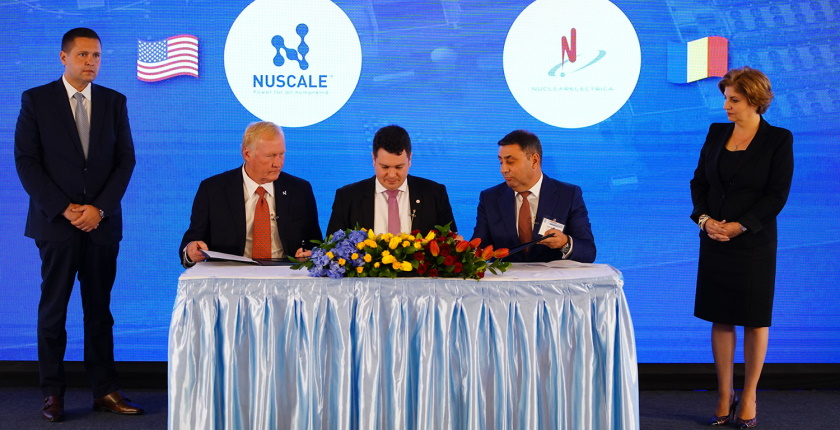
Photo: NuScale Power


Romanian nuclear energy producer Nuclearelectrica has selected the site of an old coal-fired power plant in Doiceşti, 90 kilometers northwest of the capital, for the installation of the first small modular nuclear reactor (SMR) in Romania. It broke the news in Bucharest at an SMR workshop organized by the US Trade and Development Agency (USTDA).
The Doiceşti site was chosen in line with the agreement signed in November 2021 between Nuclearelectrica and United States–based NuScale Power to build a 462 MW SMR consisting of six units. It could become the first small modular reactor in Europe.
In early 2021, USTDA awarded a grant to Nuclearelectrica to conduct a study to identify and assess several sites across Romania, including locations where existing coal-fired power plants could be replaced with SMRs.
According to NuScale power, the study, performed by US firm Sargent & Lundy, has identified several potential suitable sites including Doiceşti, which Nuclearelectrica has determined to be the preferred location.
Nuclearelectrica is also considering the construction of a solar power plant at the Doiceşti site
Cosmin Ghiţă, CEO of Nuclearelectrica, said Romania intends to establish a hub for the region in terms of the production of components, assembly and preparation of operators for the SMR technology. Of note, Romania now has one nuclear power plant – Cernavodă, close to the Black Sea coast, with an installed capacity of 1,300 MW.
Nuclearelectrica is also considering the possibility to install a solar power plant at the Doiceşti site and combine the two sources, replacing the old 550 MW power plant, Ghiţă said, local media reported.
The Doiceşti site could secure infrastructure and skilled workforce
He said Doiceşti has the infrastructure for power plants, a grid connection and skilled workforce.
NuScale Power and Nuclearelectrica have also signed a memorandum of understanding to conduct engineering studies, technical reviews, and licensing and permitting activities at the site.
John Hopkins, President and CEO of NuScale, said the agreement is yet another step forward in helping Romania to meet its climate commitments while advancing economic growth.
Small modular reactors are becoming more and more popular in the region due to the ongoing energy crisis. Of note, Romania is in talks with Washington DC–based Last Energy on a demonstrator project, while Bulgaria has signed an MoU with Fluor, also headquartered in the US.
Serbia is also interested in the installation of SMRs.


Be the first one to comment on this article.