






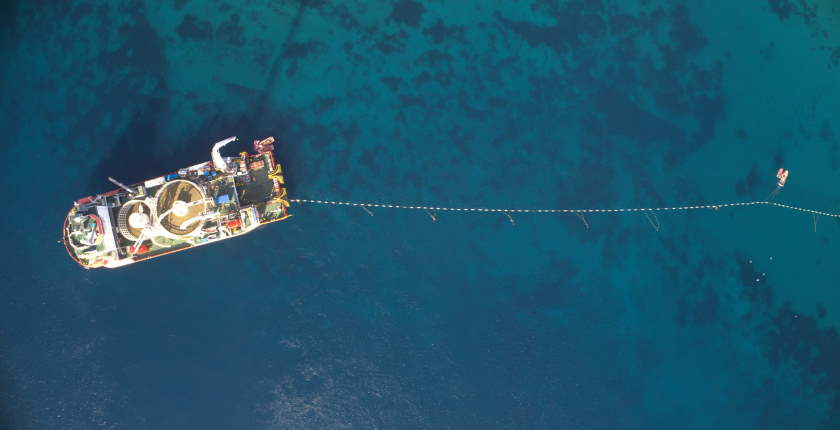
Photo: IPTO


The Ministry of Environment and Energy and the Independent Power Transmission Operator (IPTO or Admie) have announced the completion of the Crete-Peloponnese power interconnection, a step toward ending the island’s energy isolation and its transition to a cleaner energy mix.
This first interconnection of Crete to the mainland will cover one third of the island’s energy needs, substituting the production of aged local power plants which are the most costly and polluting because they are using fuel oil, according to IPTO.
The world’s longest alternating current (AC) cable, it is 174 kilometers long, of which 132 kilometers are on the seabed, and the maximum cable laying depth is 1,000 meters. The first of the two cables became operational in December 2020.
The flagship project, which cost EUR 380 million, was co-financed by Greece and the European Union, and the European Investment Bank (EIB) provided a loan.
Greece intends to reduce the installed capacity of oil-fired power plants to 300 MW by 2030 from 1.9 GW.
Electricity consumers in Greece to save EUR 400 million
Crete will be connected to the grid with another power link, a 375 km DC cable, which is also set to be the longest in the world of its kind.
Upon the full interconnection of Crete with the mainland system in 2023, when the link to Attica is due to be completed, CO2 emissions from power generation in Crete will be reduced to zero, dramatically improving the environmental footprint of the island, IPTO said.
In addition, from the withdrawal of conventional polluting power plants in Crete, all consumers in the country will save up to EUR 400 million per year in total on behalf of public service obligations (PSOs), paid through electricity bills.
No Greek island will be isolated or burn dirty fuels to produce electricity by 2030
Of note, island suppliers are compensated for the difference between their (high) generation costs and the system marginal price on the mainland through a fund that is financed by a levy charged to all electricity consumers.
Islands lie at the core of IPTO’s growth strategy. According to its ambitious 10-year plan, almost no Greek island will be isolated or burn dirty fuels to produce electricity by 2030.
Greece’s energy transition passes through the sea
Minister of Environment and Energy Kostas Skrekas said that the project is of the utmost importance for the whole country, but especially for the island of Crete where the energy demand during the summer months increases dramatically.
“By continuing the implementation of our island interconnections’ strategic plan with mainland Greece, citizens will benefit financially from the reductions in electricity prices through the PSOs while, at the same time, we manage to substantially reduce carbon dioxide emissions, thus contributing to the protection of the environment,” he added.
According to President and CEO of IPTO Manos Manousakis, the future of Greece’s energy transition passes through the sea.
“With this project, the operator has proven that it can respond even to the most demanding electrical interconnection projects and implement them consistently, achieving significant economic and environmental benefits for all citizens of the country,” he said.


Be the first one to comment on this article.