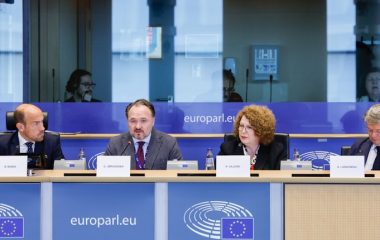









Third annual two-day EnerTech Balkans conference and exhibition was organized in Belgrade’s Hyatt hotel and gathered hydro and wind energy experts and company representatives, regulators from the region, European and government officials, civil sector representatives and consultants.
When speaking about situation in Serbian energy sector from the perspective of EU integration, Freek Janmaat, Head of the European Integration Section at the Delegation of the European Union to the Republic of Serbia stressed importance for a country candidate to follow implementation of EU policies and legislation. Janmaat welcomed Serbia’s recent adoption of new Energy law that is in line with the EU Third Energy Package. Janmaat said that one of the major challenges for Serbian Government would be to determine policy for attracting investments in renewables whereas it should balance its desire to keep electricity price as low as possible with incentives for further deployment of renewables.
Narinder Chauhan, India’s ambassador to Serbia, focused on generating interest in the region to partner with India in the renewable energy programme in the Balkans. She said her country had witnessed significant growth in the grid connected power generation and that the renewable energy sector had grown at an annual rate of about 22 % rising from about 3.9 GW in 2002-03 to about 34.95 GW now.
Zoltán Nagy-Bege from the Romanian Energy Regulatory Authority spoke about regulation in the segment of renewables, alongside colleagues from Serbia and Croatia. He said that, even though Romania could serve as a model for its results, some conclusions must also be drawn from its mistakes. Namely, Nagy-Bege believes government’s incentives in Romania used to be too generous, and that such policy attracts risk capital. In order to attract strategic investment, legislation needs to be stable and the support sustainable, he said. Still, he named ČEZ one of several good examples, with EUR 1 billion investment and its biggest onshore wind capacity in Europe.
Nagy-Bege also said predictability is important, while in Romania it is not clear how high quotas would be in the years to come.
A month before, as the Romanian government capped the annual green energy quota at the 2013 level of 11.1% of gross power consumption, managers of energy companies said they were reluctant to invest in Romania, Bucharest daily Ziarul Financiar said. After two legislative amendments within two years shook the confidence in long-term profitability, the companies’ parent groups say new projects are not credible, investors said during the ZF Power Summit ’15, Energy World magazine reported.
In 2013, the state changed the support scheme for green energy producers, by halving the number of green certificates. Last year it reduced the regulated rate of return for the distribution of energy resources from 8.52% to 7.7%.
Analysts speculate the government is trying to help large industrial consumers cut the cost of energy from renewable sources ahead of elections, and prevent production cuts and layoffs.