







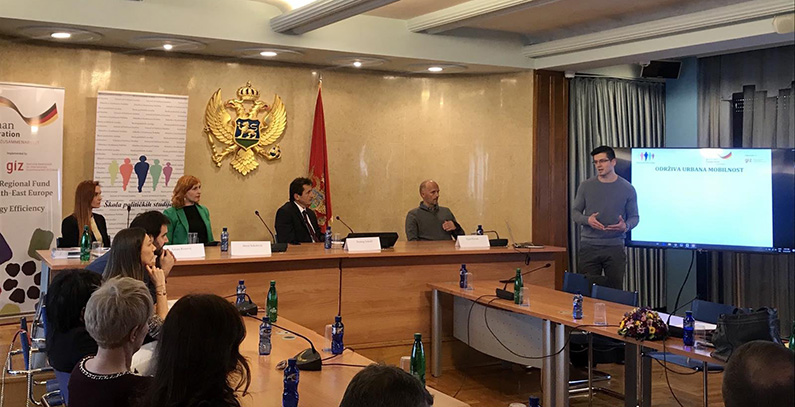
Photo: GIZ ORF-EE


National parliamentarians and parliamentary staff of Montenegro received a policy brief on sustainable urban mobility, prepared by local experts. GIZ expert Aljaž Plevnik shared his experience from Slovenia on the importance of the national level for the implementation of local sustainable urban mobility plans (SUMPs).
Lawmakers and parliamentary staff gathered at the Parliament of Montenegro on February 24, 2020, to receive a policy brief on sustainable urban mobility.
The event took place during an informative session within the parliamentary Committee on Economy, Finance and Budget. Interested in the subject, single members of the informal green parliamentary group joined the brief as well.
GIZ ORF-EE is implementing a project for competence development of parliamentarians
The session was organized with the support of the School of Political Studies in Montenegro as a part of the project for ‘Competence development of parliamentarians from South-East Europe on sustainable urban mobility topics (SPS UM)’, implemented by the GIZ Open Regional Fund for South East Europe – Energy Efficiency (GIZ ORF-EE).
 What does urban mobility imply? What is a sustainable urban mobility plan? The policy brief includes the most important information on the subject.
It also lists the laws and national strategies that demand the integration of sustainable urban mobility principles with concrete proposals for their adjustments. The policy brief has been prepared and presented by Stefan Bulatović and Blažo Crvenica, local experts of nongovernmental organization Biciklo.me.
To illustrate the implications of an SUMP, in the session, GIZ expert Aljaž Plevnik, Ph. D., presented his experiences with the SUMP process from Slovenia. He elaborated on how the successful implementation of a sustainable urban mobility plan on the local level requires joint and comprehensive commitment by many scales – the national level in particular. “The wide uptake of SUMPs on the local level is closely related to the support from the national level,” Plevnik asserted.
Plevnik: Successful implementation of a sustainable urban mobility plan on the local level requires joint and comprehensive commitment by many scales – the national level in particular
GIZ ORF-EE Project Manager Jasna Sekulović observed the awareness of sustainability in transport and mobility of cities is increasing and it is gaining momentum. “First steps towards sustainable urban mobility have just been accomplished in Montenegro, at this very day. A promising coincidence, today’s session fell on the same day as the adoption of the SUMP Podgorica by the city assembly,” she said.


Be the first one to comment on this article.