







Photo: NOAA


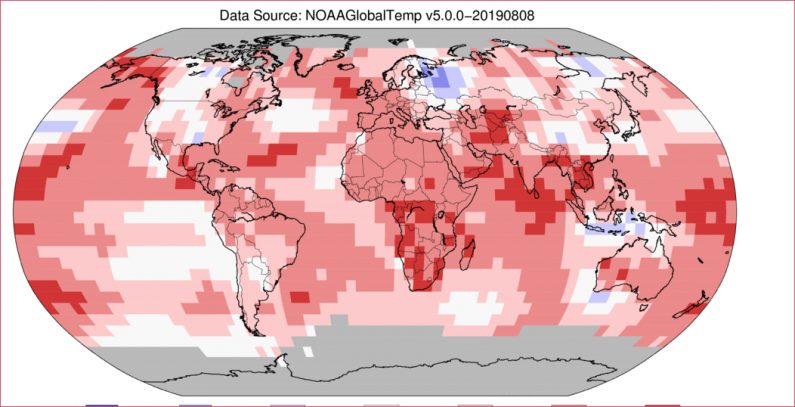
July 2019 was the hottest month on record for the planet, the U.S. National Oceanic and Atmospheric Administration (NOAA) has said in a press release. The record warmth also shrank Arctic and Antarctic sea ice to historic lows.
The average global temperature in July was 1.71°F (0.95°C) above the 20th-century average of 60.4°F (15.8°C), making it the hottest July in the 140-year record, according to scientists at NOAA’s National Centers for Environmental Information. The previous hottest month on record was July 2016.
Nine of the 10 hottest Julys have occurred since 2005 – with the last five years ranking as the five hottest. Last month was also the 43rd consecutive July and 415th consecutive month with above-average global temperatures.
The period from January through July produced a global temperature that was 1.71°F (0.95°C) above the 20th-century average of 56.9°F (13.8°C), tying with 2017 as the second-hottest year to date on record.
It was the hottest year to date for parts of North and South America, Asia, Australia, New Zealand, the southern half of Africa, portions of the western Pacific Ocean, western Indian Ocean and the Atlantic Ocean.
More notable facts and stats
Record-low sea ice: Average Arctic sea ice set a record low for July, running 19.8% below average – surpassing the previous historic low of July 2012.
Average Antarctic sea-ice coverage was 4.3% below the 1981-2010 average, making it the smallest for July in the 41-year record.
Some cool spots: Parts of Scandinavia and western and eastern Russia had temperatures at least 2.7°F below average.
Climate change impacts
In last year’s Special Report on Global Warming of 1.5°C, the Intergovernmental Panel on Climate Change (IPCC), the leading world body for assessing the science related to climate change, highlights a number of climate change impacts that could be avoided by limiting global warming to 1.5°C compared to 2°C, or more.
For instance, by 2100, global sea level rise would be 10 cm lower with global warming of 1.5°C compared with 2°C. The likelihood of an Arctic Ocean free of sea ice in summer would be once per century with global warming of 1.5°C, compared with at least once per decade with 2°C. Coral reefs would decline by 70%-90% with global warming of 1.5°C, whereas virtually all (more than 99%) would be lost with 2°C, the IPCC said.




Be the first one to comment on this article.