

News

Sarajevo gets solar benches with help from Sweden

Published

August 14, 2015

Comments

comments icon

0

Share

Published:

August 14, 2015

Comments:

comments icon

0

Share

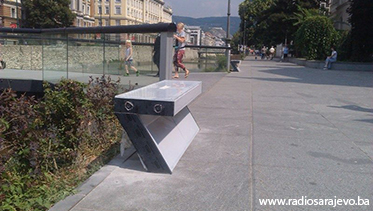
Six multifunctional seats powered by the Sun’s energy have been installed in the centre of Bosnia and Herzegovina’s capital city. The devices serve as public lighting and as chargers for mobile phones and tablets, Radio Sarajevo’s portal reported.

The solar benches give information via bluetooth about air quality, energy generation, and reduction of carbon dioxide emissions, said Amina Omičević, expert on ecology who initiated the project.

Sarajevo got its public solar-powered devices thanks to support from the embassy of Sweden. The design of the benches is based on LED technology.

Recently a very similar solar bench was constructed and installed in Solin in the south of neighbouring Croatia. Also, an inventor from Larissa in Greece created a version made of wood as a gift to his city.



Related Articles

europe eleport loan eib ev charging

Eleport secures funds for EV charging expansion in Croatia, Slovenia

22 January 2026 - Teleport operates a total of 800 charging points including over 400 fast charging points in six EU countries

croatia hep solar power plant zadar crno

HEP plans to build 91 MW solar power plant on Adriatic coast

22 January 2026 - The photovoltaic facility will be slightly smaller than the 99 MW Korlat system - HEP’s largest, which it is building nearby

North Macedonia MEMO power exchange intraday segment launch with BSP

North Macedonia’s MEMO power exchange starts work with BSP on intraday segment launch

22 January 2026 - North Macedonia's MEMO signed a deal with the Slovenian BSP Energy Exchange for the provision of trading platforms and a clearing platform

Irene Paoletti (EEIP), Urban industrial symbiosis, a path towards sustainable partnerships

Urban industrial symbiosis: a path towards sustainable partnerships

22 January 2026 - Urban industrial symbiosis can unlock major energy efficiency gains by connecting industry and cities, boosting resilience, competitiveness and decarbonisation in the EU.