






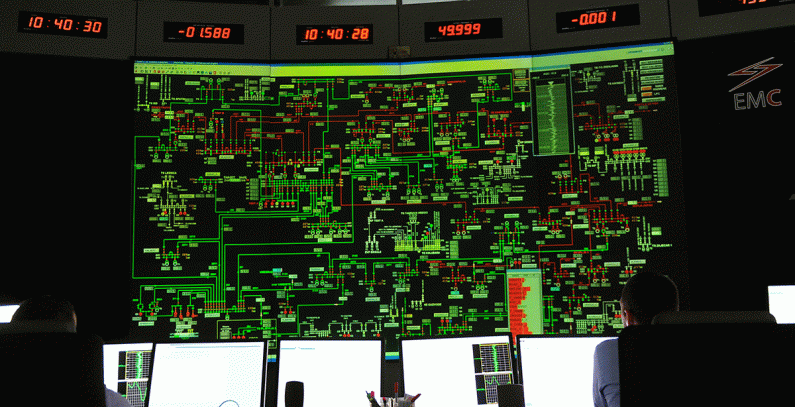
Photo: EMS


The Hungarian Power Exchange (HUPX) and the Serbian South East European Power Exchange (SEEPEX) have signed a Memorandum of Understanding (MoU) which envisages a merger between the HUPX and SEEPEX spot power businesses.
The MoU has also been signed by Serbian transmission system operator (TSO) Elektromreža Srbije (EMS) and its Hungarian peer MAVIR, as well as the European Power Exchange (EPEX SPOT).
“MoU foresees the creation of a strong cross-regional power exchange in the Central and South Eastern European region, while maintaining a steady link to EPEX SPOT. Two TSOs and EPEX SPOT would act as founder shareholders of the newly established power exchange. The latter shall rely on EPEX SPOT services regarding the operation of a Day-ahead market and Day-ahead market coupling activities”, the companies said in a statement.
According to the statement, the project remains open for additional partners who would like to join this initiative to drive forward the integration of spot power markets in Central and South-East Europe.
“The five partners see this MoU as an important milestone in the further integration of the Central Western European (CWE) region with the Central Eastern European (CEE) region. Also, by enhancing cooperation between TSOs and power exchanges in the CWE, CEE and South Eastern European (SEE) region, this partnership will be a main driver in the envisaged development and integration of the SEE region with the Internal Electricity Market,” the statement reads.
The new power exchange will be located in Budapest and Belgrade, and the schedule of the launch will be disclosed at a later stage.
SEEPEX – first non-EU power exchange in the SEE region
Serbian South East European Power Exchange (SEEPEX) is a licensed market operator for an organized electricity market. It is founded in 2015 in the form of partnership between state-owned EMS and EPEX SPOT as a joint stock company.
As the first non-EU power exchange in the SEE region, SEEPEX operates the day-ahead market.
In December 2017, SEEPEX reached 144,189 MWh of traded volume, which, as the company stated, marks the highest monthly volume from the beginning of the operation.
“This volume shows 90,5 % increase when compared to previous month and 160,7 % increase when compared to December 2016,” SEEPEX said.
Hungarian Power Exchange (HUPX) operates day-ahead, physical futures and intra-day power markets in Hungary. HUPX is established in 2010 with 100% shares in hands of the Hungarian TSO MAVIR.
In 2017, the total traded volume on HUPX DAM market increased by 4,84% to 18,578,593 MWh.




Be the first one to comment on this article.