






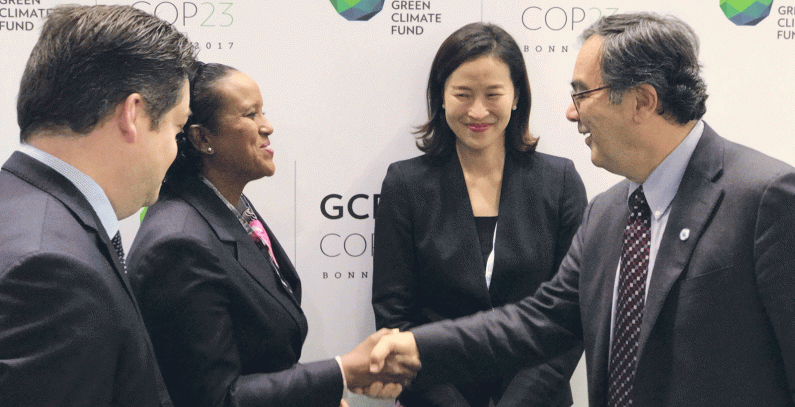
Photo: GCF


Share


The Green Climate Fund (GCF), set up by 194 countries which are parties to the United Nations Framework Convention on Climate Change (UNFCCC), will start funding its largest climate finance investment to date through projects in Armenia, Egypt, Georgia, Jordan, Republic of Moldova, Mongolia, Morocco, Serbia, Tajikistan, and Tunisia.
This investment is co-financed by the European Bank for Reconstruction and Development (EBRD) and GCF. Two sides signed an agreement on Tuesday at COP 23 in Bonn. The programme connects Asia, Europe, and Africa.
“This programme will deliver climate finance at scale via Partner Financial Institutions (PFIs) in developing countries, which will fund over 20,000 scalable and replicable projects across industrial, commercial, residential, transport and agricultural sectors,” GCF said in a statement.
The GCF will provide USD 378 million to this USD 1.4 billion programme to support thousands of individual investments in technologies that reduce emissions and enhance resilience to climate change.
Sustainable Energy Financing Facilities is an on-lending programme that will provide credit lines to PFIs with the aim to create self-sustaining markets in the areas of energy efficiency, renewable energy, and climate resilience.
The PFIs in the Programme will on-lend the funds to the borrowers such as Micro Small and Medium Enterprises, special purpose companies and households for energy efficiency, renewable energy, and climate resilience projects.
Financing activities will be complemented by the provision of technical assistance, both to the local PFIs and to the borrowers.
The Green Climate Fund (GCF) is created by 194 countries which are parties to the United Nations Framework Convention on Climate Change (UNFCCC) in 2010 to support the efforts of developing countries to respond to the challenge of climate change.
The Fund’s investments can be in the form of grants, loans, equity or guarantees.




Be the first one to comment on this article.