







The Council of Europe Development Bank (CEB), KfW development bank from Germany and Raiffeisenbank (Bulgaria) e. a. d. (RBB) successfully closed an EU grant-supported Finance Facility Energy Efficiency Window for SMEs (SMEFF-EE) based in Bulgaria. Econoler said it had been hired to support RBB and the applying SMEs in identifying, developing and implementing energy efficiency subprojects that were subsequently financed by KfW’s credit line. The endeavour was completed at the end of October, according to the company’s statement.
With a worth of EUR 30 million, SMEFF-EE was designed to serve two main purposes: to increase SMEs’ competitiveness and to offer the firms easier access to energy efficiency financing by providing a grant.
Since the SMEFF-EE’s implementation officially started on April 11, 2014, Econoler has reviewed over 300 subproject applications and prepared a total of 259 technical evaluations. Of the approved sub-projects, 231 were successfully implemented and verified, and a total amount of EUR 32 million in investments was mobilized. The beneficiary SMEs were in six economic sectors: agriculture, cargo (freight) transport, passenger transport, services (including retail and wholesale trade, equipment and machinery service and maintenance), manufacturing, and buildings and construction. The environmental target set by the program for all kinds of vehicles, and manufacturing and farming equipment was at least 20% energy savings, or 20% reduction in emissions of carbon dioxide, while for buildings and construction the target was 30%.
It is expected that almost 30 GWh will be saved each year and 8,000 tons of CO2 emissions will be avoided annually thanks to the programme.
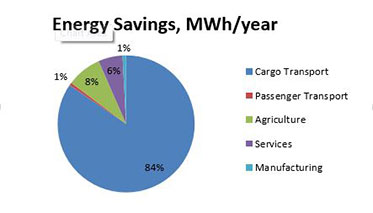
It is expected that almost 30 GWh will be saved each year and 8,000 tons of CO2 emissions will be avoided annually thanks to the programme. Most of the energy savings and greenhouse gas emission reductions were achieved in the transportation sector, cargo in particular. This sector not only had the biggest percentage of all the subprojects, but also had some with significantly larger investment values. One of the key factors contributing to the SMEFF-EE’s success was the effective communication with RBB and the participating SMEs, which facilitated the application and project assessment procedures, Econoler said.
The company is based in Sofia, as a subsidiary of Econoler Canada, a consulting firm specializing in the design, implementation, evaluation and financing of energy efficiency programs and projects.