

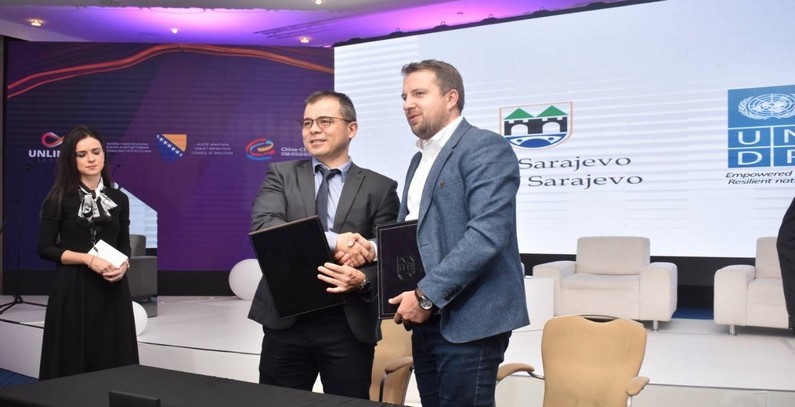
The City of Sarajevo and the UN Development Programme (UNDP) in Bosnia and Herzegovina (BiH) have signed a Memorandum of Understanding (MoU) officially launching cooperation under the Sarajevo – Smart City Initiative. The project will support identification and piloting of technology-based solutions that help improve public services such as those in the area of air quality, waste management and public transport, UNDP in BiH said.
Sarajevo – Smart City, a pilot initiative financed by UNDP, is aimed at opening a dialogue among citizens, authorities, academia and the private sector on the Sarajevo of the future and test innovative solutions for digital urban planning, technology-based improvement of public services and smart urban economy.
The MoU was signed by Sarajevo Mayor Abdulah Skaka and UNDP Deputy Resident Representative Sukhrob Khoshmukhamedov.
“The project will support identification and piloting of technology-based solutions that help improve public services (e.g. air quality, waste management, public transport, etc.). It will also support implementation of innovative solutions that not only contribute to more effective and productive businesses, but essentially – that affirm new technology-based solutions that ensure stronger connectivity between urban economy and the wider city ecosystem,” said Khoshmukhamedov.
The initiative will rely on the engagement and contribution by prominent and knowledgeable citizens of Sarajevo grouped within the City Mind Lab, which is expected to steer the process and contribute with innovative ideas and solutions, UNDP in BiH said.
“Development of Sarajevo City is accelerating in terms of infrastructure, economy, tourism growth, and City is becoming a regional center. This needs to be accompanied by the application of contemporary and smart solutions by city administration. Introduction of smart technologies is seen as one of priorities for this administration, which is why the initiative we are launching today represents a significant step in a right direction,” said Skaka.
A pilot area within the City of Sarajevo will be selected as a “testing field” for the implementation of several inter-connected activities, which can be scaled-up. The project will facilitate the design of a virtual reality/3D tool to help territorial visualization and creation of the “digital mahala 2050” projection based on citizens’ vision, and subsequently support small-scale initiatives that will help transform the vision into reality, according to the statement.