






Photo: Ministry of Economy /Facebook


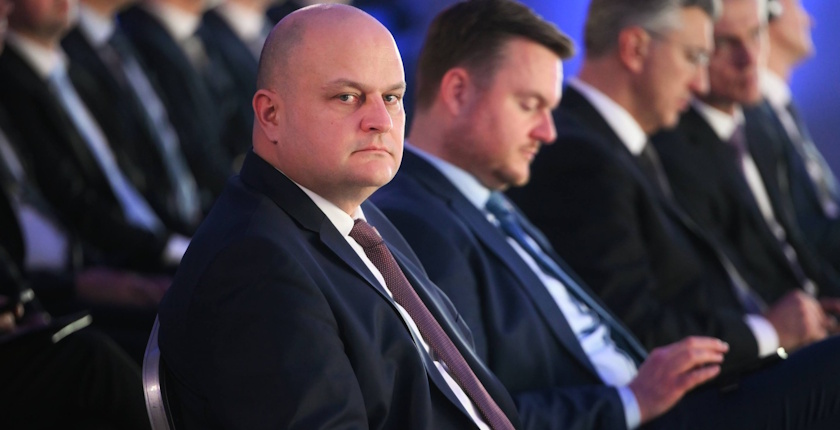
Croatia has spent EUR 4 billion so far to subsidize renewable energy, according to Minister of Economy Ante Šušnjar. He added the money could have been put to better use, and stressed that the government would no longer provide incentives for wind and solar.
Economy Minister Ante Šušnjar noted that the energy transition in Croatia didn’t begin yesterday, but about fifteen years ago, when decisions were being made for the next decade.
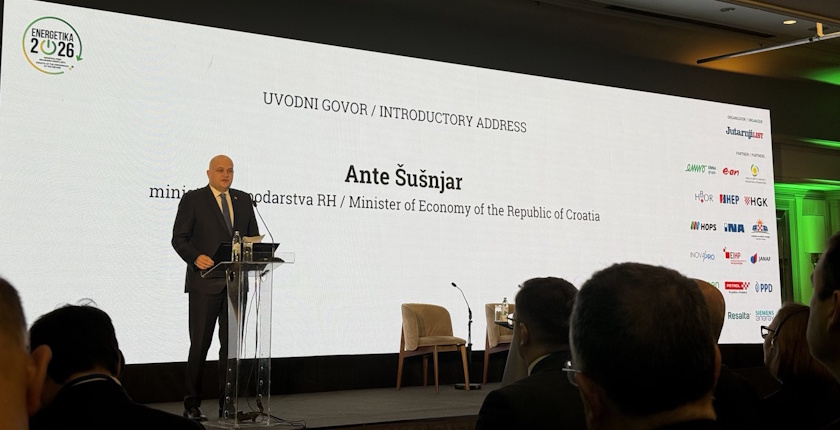
“Today, without any hesitation, I can say that some of them were not good: incentive models that were set too fast, without sufficient analysis of the energy system, and without enough care for the grid and consumers. All this comes at a price, which we are still paying,” Šušnjar said at the Jutarnji List energy conference on the country’s decisions for next decades.
The event in Zagreb brought together several hundred participants.
He recalled that in the early stage of the transition, the government decided to incentivize solar power plants with feed-in tariffs of EUR 300 per MWh.
But Croatia could have paid several times less ten years later, he added. A similarly ambitious approach was taken with wind power incentives, in his view.
Šušnjar: It was a rushed move
It was a rushed move, he underscored. In Šušnjar’s view, even investors themselves didn’t realize at the time that the return on investment would come in at four or five years, while the feed-in tariff contract lasts for 12 years.
He also criticized subsidies for biogas and biomass plants. Biogas facilities will not be commercially viable even after 12 years in the feed-in tariff system, with EUR 190 per MWh, while the latter ones don’t know what to do with thermal energy even though, at the same time, the industry desperately craves decarbonization and heat, the minister asserted.
I’m not skeptical about renewables
“So far, we have spent over EUR 4 billion on incentives for electricity generated from renewables. Do you know the result for the economy? The gross value added in the supply of electricity, gas, steam, and air conditioning sector has decreased for the last 10 years by about 25%,” Šušnjar stressed.
He underscored that he isn’t skeptical about renewable energy sources; on the contrary. “And we took an important, but financially generous step to incentivize renewables, without analysis and a perspective on how it would turn out,” he underscored.
Foreign ambassadors and feed-in tariffs
According to Šušnjar, foreign ambassadors in Croatia, representing the interests of foreign investors, often ask him when the feed-in tariffs for solar projects will be allocated. Still, their countries stopped providing them 15 to 20 years ago, he added.
“There is no need for feed-in tariffs. The time for incentivizing solar and wind is behind us. These technologies are available at affordable prices on the market,” he explained.
The surcharge for renewable energy sources paid by consumers won’t increase. And for the industry, it can only be reduced.
“We are continuing with the development of renewable sources, but in a balanced and responsible manner,” Šušnjar concluded.

Be the first one to comment on this article.