

The Climate Smart Bio-Waste Management Challenge is open until April 22. Local authorities, public enterprises, scientific research institutions and civil society organizations can propose ideas for tackling biowaste in the project organized by the UNDP and the Government of Serbia with SIDA’s support.
The United Nations Development Programme (UNDP) and Serbia’s Ministry of Environmental Protection launched the Climate Smart Bio-Waste Management Challenge. The project was started to support innovative solutions for tackling biodegradable matter, particularly from food that’s thrown away and other kitchen waste as well as biowaste from greenery and gardens in Serbia.
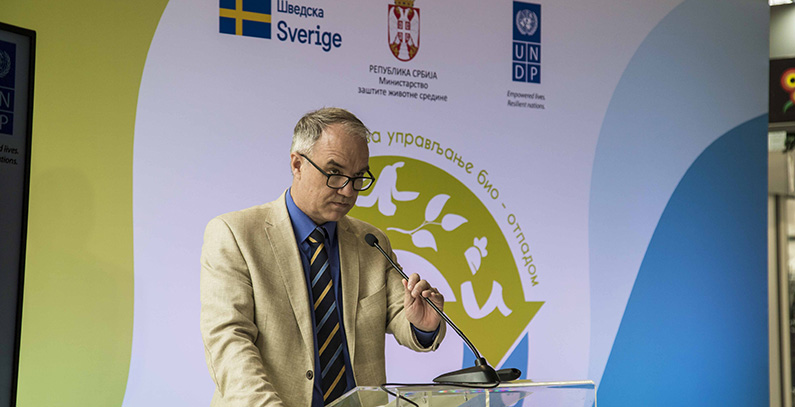
Swedish International Development Cooperation Agency – SIDA backed the endeavor financially. It was presented at the green market in Palilula in Belgrade. The organizers said they want to stimulate solutions that lower greenhouse gas emissions and boost the utilization of renewable sources in energy production.
Applicants should offer ideas that would lead to a reduction in greenhouse gas emissions and boost the utilization of renewable sources in energy production
The public call is open through April 22 for local authorities, public enterprises, scientific research institutions and civil society organizations. Selected teams will get mentoring from professionals and the top five are eligible for cofinancing aimed at the implementation of their ideas. They will also have the opportunity to go to Sweden for study visits.
Project for mutual learning
Ambassador Jan Lundin said such initiatives are important for the environment but also for Serbia’s economy, adding they would open jobs. The Swedish envoy stressed the project is for an exchange in ideas and mutual learning.
“Within the support that Sweden provides to Serbia so that its process of joining the European Union would be accelerated, we are helping Serbia to improve the way it manages waste,” he stated and asserted there are numerous good examples in his country including business practice.
Introducing EU rules, best practice
Biljana Filipović-Đušić, deputy environment minister, pointed to the preparation of Serbia’s waste management strategy from 2020 to 2025 and said it must comply with five European Union directives on circular economy. The document is expected to be adopted this year, in her view.
“Reusing biodegradable waste is in line with the procedure to introduce circular economy in Serbia together with the best practice from EU countries and European legislation. This particular project will make it easier to establish the infrastructure for biowaste management; above all, for the collection and separation from other types of waste,” she stated.
The state official noted the EU goal is to reach the share of recycled waste of 65% by 2035 and that less than 10% goes to landfills. Filipović-Đušić underscored Serbia should strive to achieve the said objectives.
Biowaste management helps economy, citizens of Serbia
Francine Pickup, UNDP’s resident representative in the Balkan country, said the organization is helping to cut pollution and improve resource efficiency and that it aims to contribute to hiring and the reduction in greenhouse gas emissions. The Climate Smart Bio-Waste Management Challenge should result in many good proposals and benefit the economy, environment and citizens, she added.
Only 1% of total biowaste in Serbia is processed and losses are estimated at EUR 50 million per annum
Improvements in biowaste management lead toward several sustainable development goals of the UN, Pickup stated.
UNDP said in the press release that Serbia collects 900,000 tons of biodegradable waste per year but that 70% goes to poorly run landfills and harms the environment while adding to emissions of harmful gases. Only 1% of total waste is processed and losses are estimated at EUR 50 million per annum, according to the UN agency.