



News

Energy efficiency certificate for new housing project

Published

October 21, 2015

Comments

comments icon

0

Share

Published:

October 21, 2015

Comments:

comments icon

0

Share

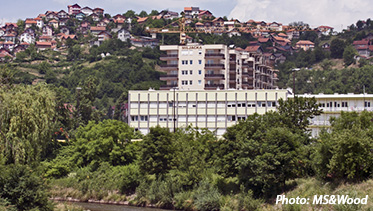
Enova, an independent certifying agency for residential buildings, issued an energy certificate for Miljacka project, which is being built in Sarajevo, developing company MS&Wood d. d. said. From 2013 the certificate is obligatory for all new objects and old public buildings.

Units in Miljacka quarter, named after Sarajevo’s main river, have façade insulation 15 centimetres thick, as well as thermal insulation between apartments and towards corridors. Windows with PVC frames have three glass layers, which is one of the first such applications in Bosnia and Herzegovina. Flats have individual calorimeters and water metres. Sarajevo needs a revolution when it comes to solving the greatest causes of air pollution, the biggest one being energy inefficient apartments, said Hrusto Tupeković, head of Miljacka project. When BiH joins the European Union, it won’t be possible to sell flats and houses without the certificate, he underscored.

Related Articles

slovenia trucks fee pollution noise

Slovenia introduces air pollution, noise fee for trucks

16 February 2026 - The amendments to the Toll Act transpose the European Union’s Eurovignette Directive into national legislation

serbia azerbaijan gas fired power plant agreement

Serbia, Azerbaijan sign agreement to build gas-fired power plant

16 February 2026 - The combined cycle plant is expected to have an installed capacity of around 500 MW, with the investment estimated at EUR 600 million

bih hydrogen project energoinvest epbih H2OIE cei

BiH starts working on national hydrogen strategy

13 February 2026 - The implementation of the CEI Support to Hydrogen Strategy Development and Know-How Transfer for BiH project began in Sarajevo

barcelona spain solar capacity 50 GW

Spain’s solar power capacity tops 50 GW

13 February 2026 - Spain’s total solar capacity currently stands at around 50.2 GW, or 34% of the overall electricity generation capacity, according to REE