






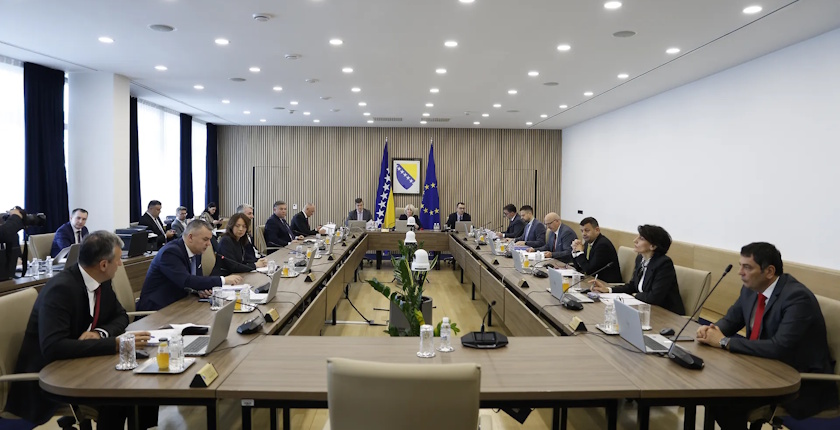
Photo: Council of Ministers of BiH


The Council of Ministers of Bosnia and Herzegovina approved a loan that power utility Elektroprivreda Bosne i Hercegovine would take from the European Investment Bank for the construction of the 90 MW Bitovnja wind farm.
At the proposal of the Ministry of Finance and Treasury, the Council of Ministers of Bosnia and Herzegovina has confirmed that the European Investment Bank’s (EIB) loan to state-owned Elektroprivreda Bosne i Hercegovine (EPBiH) falls within the scope of the framework agreement between BiH and the EIB.
The bank will approve a EUR 56 million loan to the company to finance the development of wind power plant Bitovnja in the Herzegovina-Neretva Canton, according to the council.
The company fully bears the risks of loan repayment to the EIB
EPBiH will fully bear the risks of loan repayment and financing and is providing the bank with all necessary guarantees for the approval of the loan, the update reads.
The Ministry of Finance and Treasury of BiH will inform the EIB of the council’s decision.
The wind farm would be installed on the Bitovnja mountain, about ten kilometers north of Konjic
The company has been developing the Bitovnja wind farm project for several years.
In January 2025, EPBiH prepared the preliminary environmental impact assessment for the investment.
The wind farm would be installed on the Bitovnja mountain, about ten kilometers north of Konjic, on a mountain ridge, at an altitude between 1,530 and 1,700 meters.
EPBiH plans to phase out coal-based electricity production by 2050
The annual production of the wind farm is estimated at up to 220 GWh, and the investment at BAM 215 million (EUR 110 million).
The project will be financed by loans from Germany’s KfW Development Bank and the EIB. Additional funds will also be provided through a KfW grant and the company’s own resources, according to the EPBiH website.
EPBiH currently has one wind farm – Podveležje. The majority of the company’s production comes from the Kakanj and Tuzla coal-fired power plants and hydropower plants.
It plans to stop using coal for energy production by 2050.

Be the first one to comment on this article.