





Photo: GIZ ORF-EE


Share


The Centre for Energy Efficiency of Macedonia (MACEF) hosted on November 9 in Skopje the 4th Partner Meeting of the consortium of the Facilitating multi-level governance in energy efficiency (multEE) project.
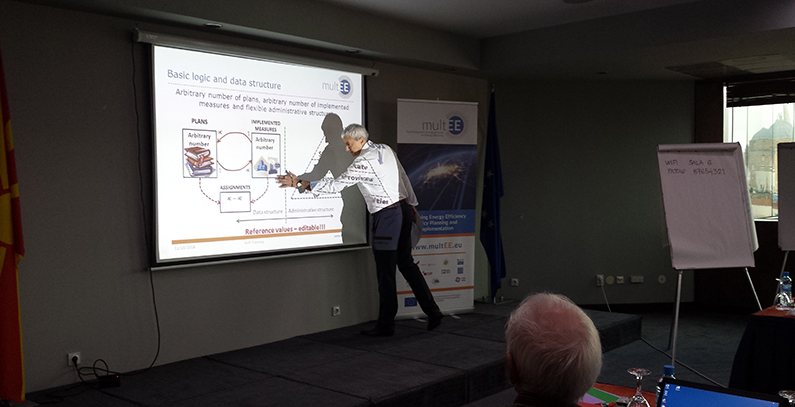
The meeting brought together important partners from EU and non-EU countries. The following day the Training on the System for Monitoring and Verification (MVP) of energy efficiency measures was held. It was implemented by the GIZ Open Regional Fund for South-East Europe – Energy Efficiency, in close collaboration with MACEF. The training brought together representatives of ministries, research institutions, energy agencies and others.
The main focus of the coming together was the introduction of the English proto-type version of the MVP. The aim of the training was to transfer knowledge on the System for Monitoring and Verification to partner EU and non-EU countries. The training included participation of up to two national system administrators from institutions of the partner countries of Macedonia (FYR), Croatia, Lithuania, Latvia, Denmark, Greece, and Slovakia.
Dr. Christos Tourkolias, one of the training participants coming from the Centre of Renewable Energy Sources and Savings from Greece stated that “the interesting aspect of the training was the holistic presentation on the MVP tool.” He further explained that “based on the introduction of the MVP system into national systems, decision-making processes in the energy sector will be improved and monitoring of energy efficiency measures will become more effective, leaving no space for potential double counting of implemented measures. All this will enable the initiation of immediate actions in each of the countries in case potential deviations, from the established energy targets, are encountered.”
The underlying idea behind the introduction of the system on national level and this training was the correct evaluation of the impacts and results of energy efficiency measures, which can be used for future policy formulation in partner countries.
The training was held as part of the multEE project, which is implemented through the GIZ Open Regional Fund for South-East Europe – Energy Efficiency. The project is co-funded by the German Federal Ministry for Economic Cooperation and Development, and the EU, under its Horizon 2020 research and innovation program.

Be the first one to comment on this article.