







Photo: BETD/Thomas Trutschel/photothek.de


To achieve the global goal of tripling the renewable electricity capacity by 2030, the largest emitters of CO2 emissions in G20 and beyond would need to more than double their annual additions, according to the International Renewable Energy Agency.
Yet, progress falls short and is unevenly spread in a few economies, according to data published by the International Renewable Energy Agency (IRENA) in its capacity as the custodian agency tasked with monitoring progress towards the UAE Consensus, reached at the CCOP28 climate summit in Dubai.
The data was released during the Berlin Energy Transition Dialogue (BETD) event.
“The know-how is there. The solutions exist. Now, we need bold action, stronger policies, and scaled-up investment to close the financing gap and accelerate the energy transition,” IRENA Director-General Francesco La Camera, who participated at BETD, wrote on LinkedIn.
La Camera: Innovative financial mechanisms must be expanded
He highlighted regulatory environments as a means to mitigate energy transition risks and financing as a major barrier.
Policy frameworks must not only outline climate and environmental plans to boost renewable energy deployment but also address energy security concerns through renewables, the head of IRENA said.
According to La Camera, innovative financial mechanisms such as blended finance, risk guarantees, and concessional funding must be expanded to de-risk investments and unlock capital.
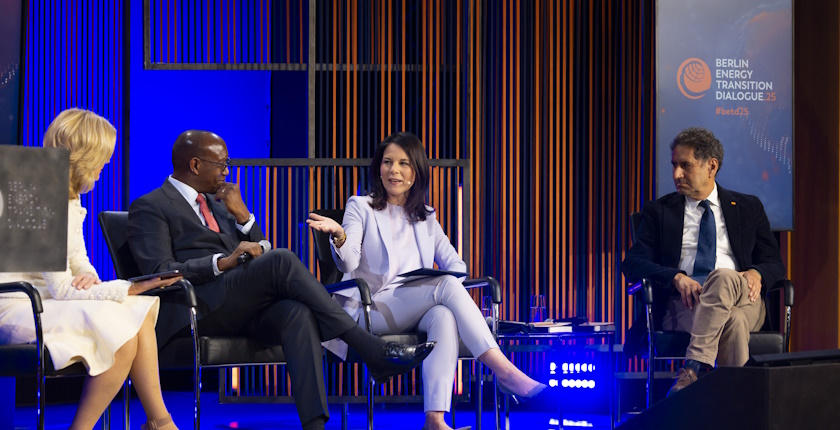
He was one of the keynote speakers in Berlin together with German Minister for Foreign Affairs Annalena Baerbock and the African Development Bank Group Vice President Kevin Kariuki.
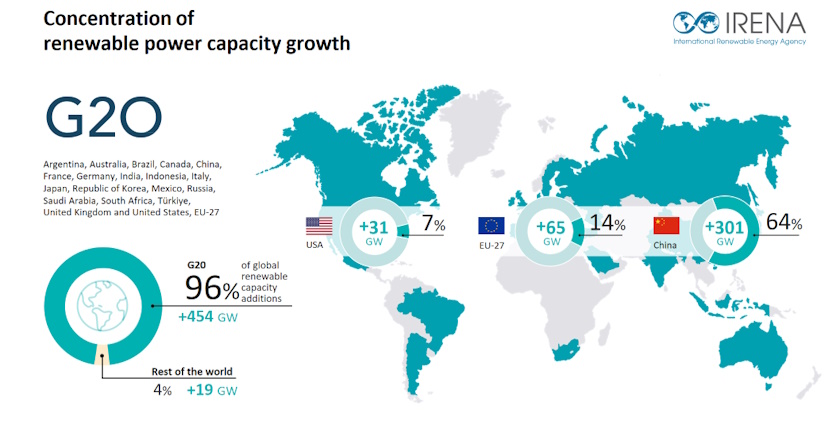
G20 nations represent 80% of global energy consumption and account for over 80% of global energy-related CO2 emissions
The agency’s new data collection and policy recommendations cover key performance indicators for the 2030 milestone and assess progress against 1.5 degrees Celsius-aligned transition pathways in the G20, which includes the European Union.
IRENA recalled that G20 nations represent 80% of global energy consumption and account for over 80% of global energy-related CO2 emissions.
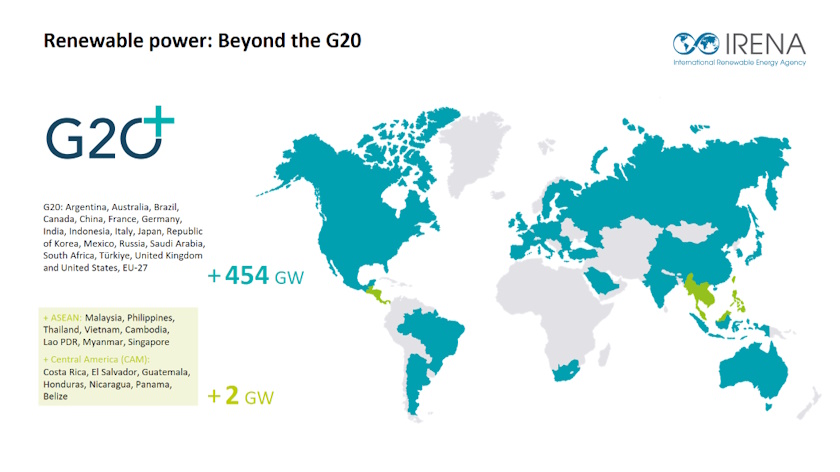
The new dataset shows the deployment of renewables and the gap to reach the global tripling target not only in the G20 but in 15 additional countries in Asia and Central America (Malaysia, Philippines, Thailand, Vietnam, Cambodia, Laos, Myanmar, Singapore, Costa Rica, El Salvador, Guatemala, Honduras, Nicaragua, Panama and Belize).
The group of countries, named G20+, would have to provide as much as 80% of total installed renewable electricity capacity by 2030, the statistics show.
In IRENA’s 1.5 degrees Celsius scenario, installed capacity would need to increase from the current 3.4 TW to 9.4 TW across G20 and from 3.5 TW to 9.7 TW across G20+ by 2030. The total is the bulk of the global goal of 11.2 TW by 2030.
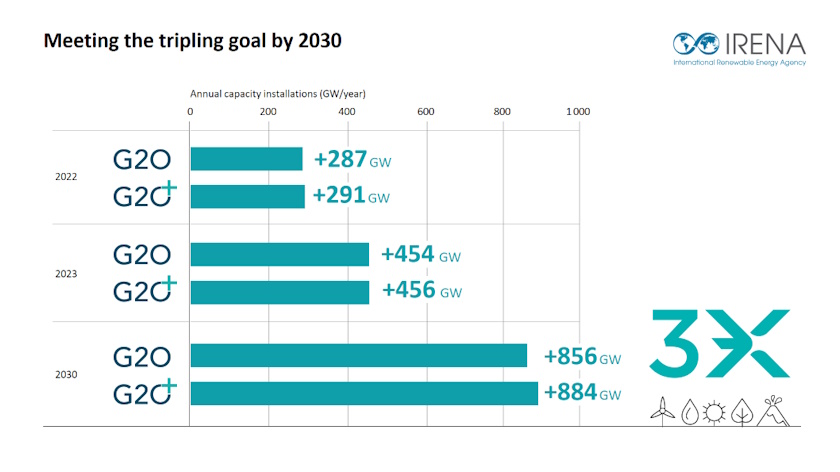 “It all hinges on progress in G20 and beyond. The largest economies in the world hold the key to tripling renewables by 2030 globally. IRENA’s data clearly shows that renewables represented almost 90% of the world’s total power capacity additions, a veritable historic milestone for renewables. But to implement the global goal, progress must be balanced across multiple countries and regions. 1.5°C calls for more ambition and more action in G20+ countries,” La Camera stressed.
IRENA outlined additional recommendations on priority actions for 2025:
- Electrification of key end-use sectors such as mobility, heating and cooling requires the development of grids, digitalisation, and flexibility solutions.
- Direct use of renewables in end-use sectors such as increased use of sustainable biofuels in shipping and aviation requires targeted investments and policy interventions.
- Energy efficiency must double and clean hydrogen and its derivatives as well as other clean technologies will require further technological advancement.


Be the first one to comment on this article.