







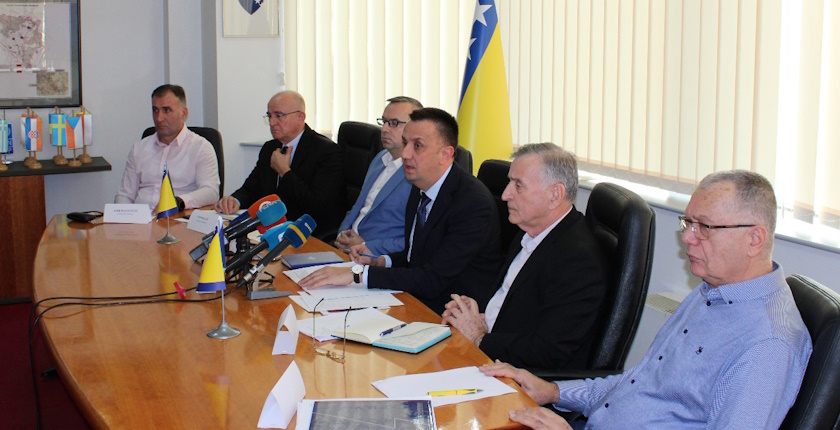
Minister Vedran Lakić with associates (photo: Vedran lakić/Facebook)


Share


The Ministry of Energy, Mining and Industry of the Federation of Bosnia and Herzegovina has started the procedure for the development of an energy sector transition strategy until 2030 with projections up to 2050.
Federal Minister of Energy, Mining, and Industry Vedran Lakić said his ministry lacks strategic documents to direct its future activities, Akta reported. He came into office in April 2023.
Lakić added that in addition to the energy sector transition strategy, the ministry started work on a mineral resources management strategy up to 2030 with projections up to 2050, an environmental impact assessment study for the program for regional geological exploration of oil, condensate, and natural gas, and studies on of geological reserves and coal quality as well as on geothermal energy.
“You cannot do much in the energy sector if strategic documents are missing,” Lakić stressed. The ministry will invite experts to get involved in the preparation of these documents.
The ministry issued 810 permits for the construction of power plants
FBiH wants to know if there is natural gas, oil, coal, and geothermal energy, Lakić said at a presentation of the ministry’s results and plans.
The minister noted that the laws on renewables and efficient cogeneration, energy and regulation of energy activities, and electricity have been adopted. By-laws for their implementation have been or will be rolled out soon, he added.
The ministry issued 342 permits for the construction of power plants up to 1 MW each and 468 for ones above 1 MW and asked the Government of FBiH to approve the construction of 33 power plants.
The law on the closure of the Zenica brown coal mine is prepared
Lakić expressed confidence that laws on electricity and gas would be adopted on the BiH level, praising cooperation with the Republic of Srpska, the country’s other constitutional entity.
The government passed a mining law and drafted one that would cover the closure of the Zenica brown coal mine. Lakić said the facility must be shut down, arguing that it accumulated a BAM 20 million (EUR 10.2 million) loss over the past years. It spilled over to power utility Elektroprivreda BiH (EPBiH), he added.
Coal power plants are harming the environment, however they are currently producing baseload energy and must be kept in operation. The current energy system must be maintained by FBiH in the next three to five years with simultaneous investment in other energy sources, Lakić claimed.



Be the first one to comment on this article.