







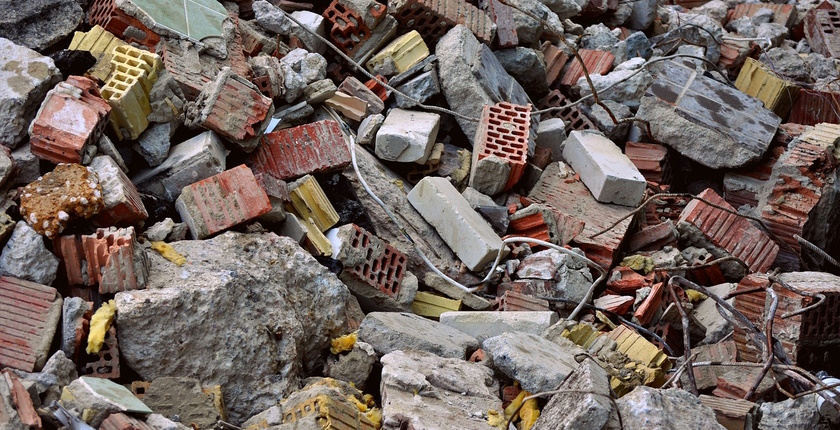
Photo: M. H. from Pixabay


Croatia generates 1.7 million tons of construction waste per year but is often difficult for the producers of construction materials that can reuse it to obtain it as a secondary raw material. It is one of the key messages from the conference Earthquake Recovery and Construction Waste in a Circular Economy: Sustainability for the Future, organized by the Croatian Chamber of Economy (HGK).
Croatia is constantly increasing the amount of construction waste it generates. According to a report from the Ministry of Economy and Sustainable Development on construction waste management in 2021, the total amount was estimated at 1.67 million tons, or 16.8% more than in 2020.
Luka Burilović, president of HGK, said almost 70% of construction waste can be recycled and reused. In a time when prices of raw materials and commodities are growing, Croatia has an opportunity to reuse the secondary raw material and it must take advantage of it, he asserted.
At least 10% to 15% of primary raw material in the production of building materials can be sourced from recycled waste
In the production of building materials, there is a possibility to substitute at least 10% to 15% of primary raw material with recycled construction waste.
Croatian manufacturers of construction materials have the potential to recycle and reuse as much as 1.5 million tons of construction waste for new products, said the president of the Association of Non-Metal and Construction Materials Industry of HGK, Davor Blažek.
But, in his words, they often can’t access the needed quantities. The industry hopes the circumstances will change so that there are as few photos of illegal construction waste dumps as possible, he added.
The solution is to have more recycling yards and processing centers
According to Mirjana Čagalj, HGK’s vice-president for construction and transport, the construction industry must do its part in the disposal of some of the waste, and cooperate on returning it to the production chain. But it is also necessary to develop the system of recycling yards and processing centers and simplify procedures for companies.
Branko Bačić, Deputy Prime Minister and Minister of Spatial Planning, Construction and State Property, also pointed to recycling yards as a solution. He underscored that Croatia has not yet met the European Union’s targets.
To do that, the government must facilitate the establishment of recycling yards throughout the country, where the waste would be processed, and an increase in the activities of around 300 companies handling it, Bačić said.

Be the first one to comment on this article.